Counting the Final Moments of an Empire
A couple of years ago, I was browsing eBay for watches—because what else would I be doing?—when I came across an interesting piece. At first glance, it wasn’t anything special. Just another Russian watch with an acrylic crystal and a manual-wind movement, distinguished only by the curious detail of a mosque on the dial. I hadn’t paid much attention to Russian watches before that moment, but that dial hooked me enough to send me deep down the rabbit hole.
To understand just how deep into the rabbit hole this took me, we have to travel back to 1990. The Soviet Union was collapsing. Most factories were idle. But in a small industrial town called Chistopol, workers were still assembling watches under the proud name Vostok.

The Communist Party was losing its grip, shortages were everywhere, and the map was being redrawn. Inside the factory, though, production remained stubbornly mechanical and predictable: the slow, familiar rhythm of gears, springs, and balance wheels being brought to life.
Among the countless models rolling off the lines—dials stamped with tanks, paratroopers, submarines, red stars, and regimental crests—a small number emerged with an entirely different emblem: a mosque.
It was one of those watches, a Vostok Komandirskie, that caught my eye then and sits on my wrist now.
It’s a relic of contradiction: a military watch with a mosque on the dial; Cyrillic inscriptions praising Soviet industry wrapped around a symbol of Islamic devotion; a commander’s tool carrying a dome and minaret instead of a tank, or a hammer and sickle. It tells a story not just of timekeeping, but of identity, faith, and survival at the twilight of an empire.
The Watch In Question
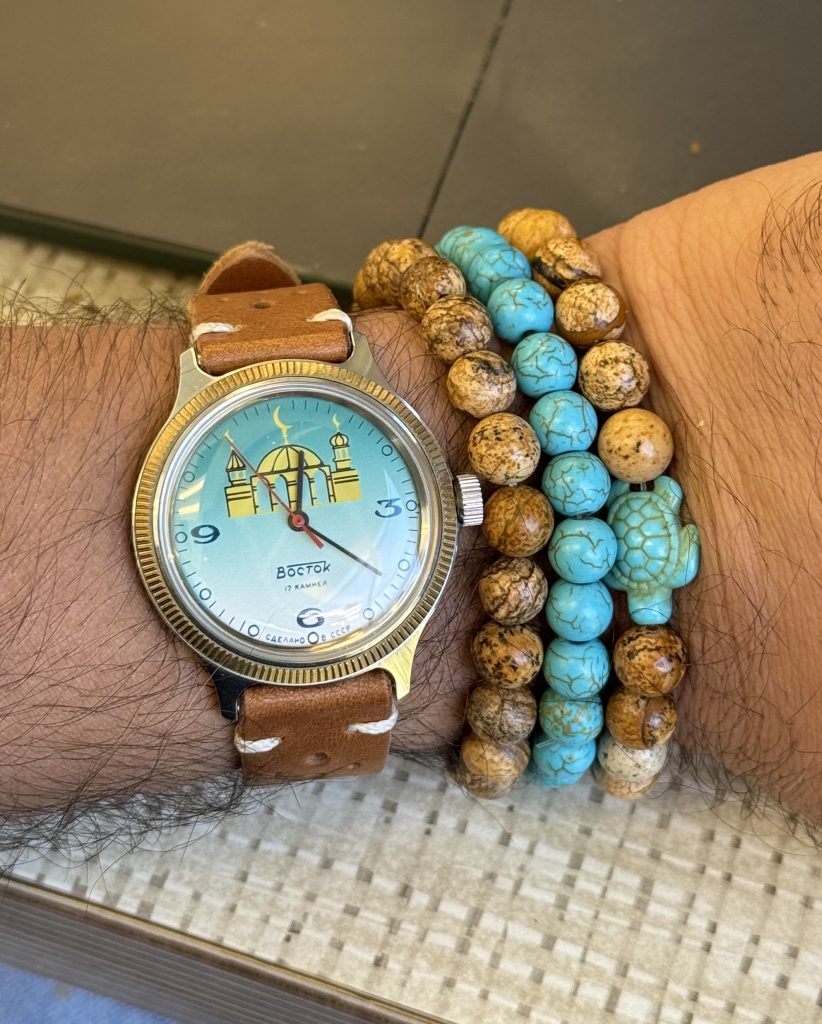
Physically, the mosque-dial Komandirskies are utterly ordinary—and that ordinariness is precisely what makes them so cool (in my exceedingly humble opinion of course). Inside beats a Vostok 2414A manual-wind movement with 17 jewels and roughly 36 hours of power reserve when fully wound. Clearly not “haute horlogerie”, but robust, easily serviced, and intriguing in its simplicity.
Their cases are usually chrome-plated brass, measuring about 39 millimeters across, with the classic Vostok profile: stubby lugs, modest thickness, and a screw-down back. On mine, the plating shows its age—nicks, softening, and the occasional hint of brass peeking through where life has worn the shine away. Covering the dial is a domed acrylic crystal, easily scratched but just as easily polished back to clarity; viewed at an angle, it bends the indices into a subtle, almost watery distortion.
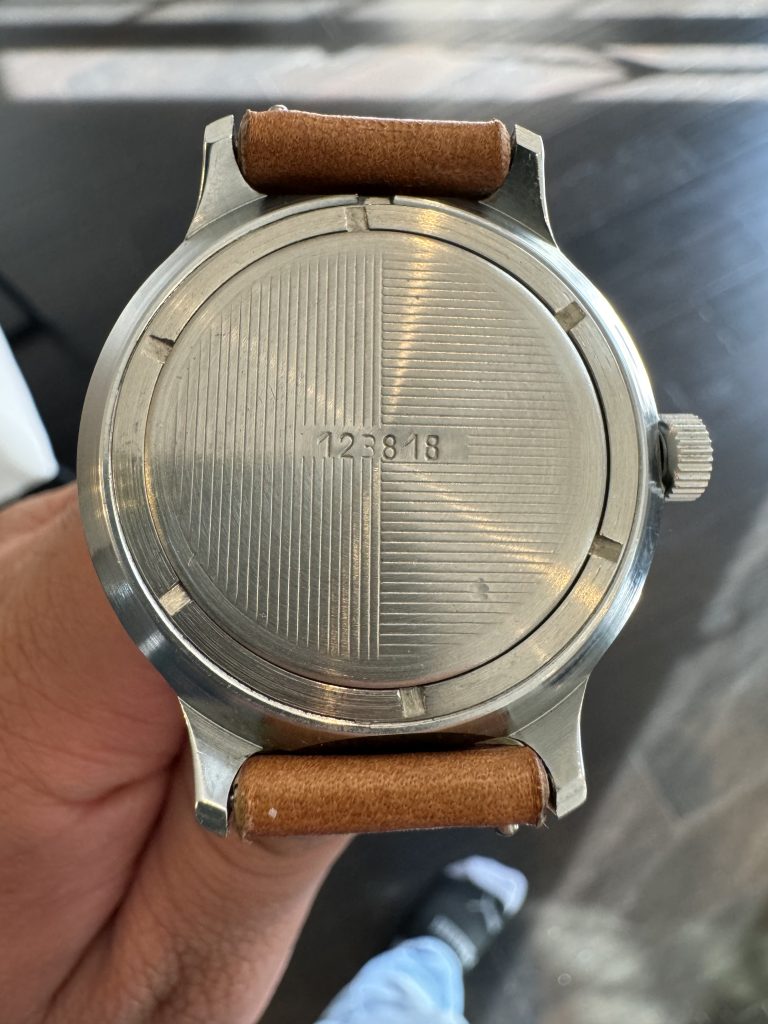
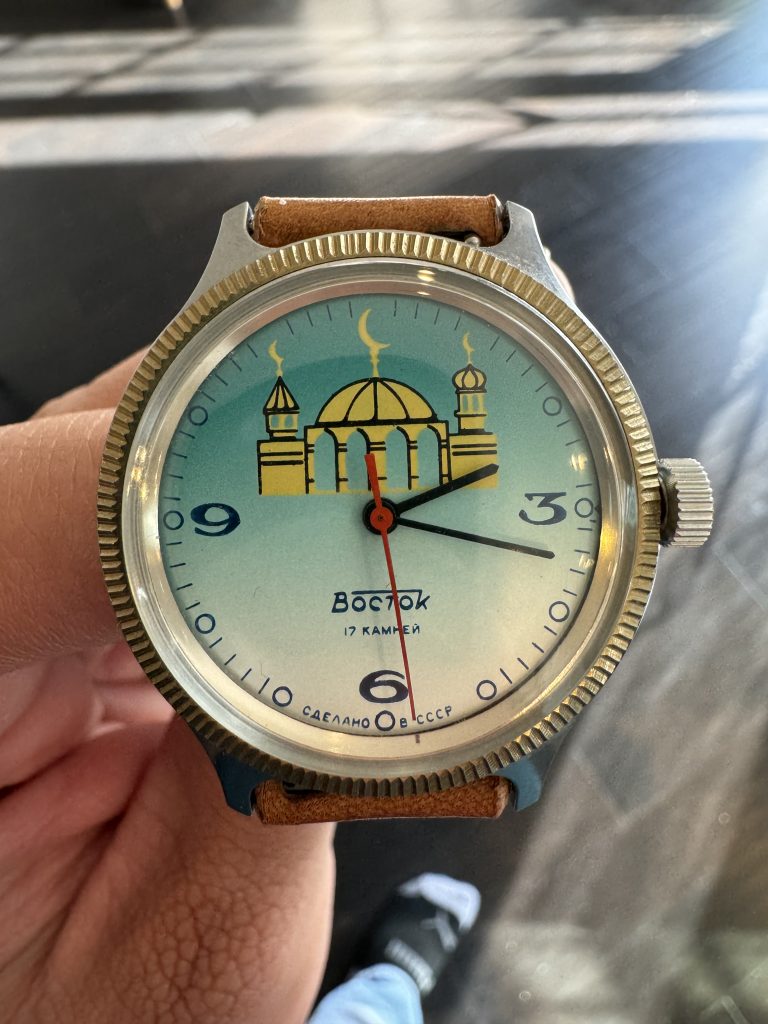
The screw-down stainless-steel caseback is sometimes stamped “Водонепроницаемые”—‘waterproof’ (although not on mine). Though given its age and lack of a screw-down crown, I will never let it near water again. Across the dial, Cyrillic text anchors it firmly in its time and place: “Восток” (Vostok), “17 камней” (17 jewels), and “Сделано в СССР” (Made in the USSR). Together, these humble details give the watch a quiet credibility, witnessed not through spectacle but through honest use.
But why was all of this surprising? To understand why a mosque on a Soviet military watch feels so improbable, you have to start with the watch that came before the dial. The Komandirskie (Командирские—literally, “Commander’s”) was born in 1965 under an order from the Soviet Ministry of Defense. This was not a fashion watch, nor a prestige gift for party officials. It was an issued tool: a soldier’s instrument created by the Chistopol Watch Factory, later known as Vostok.
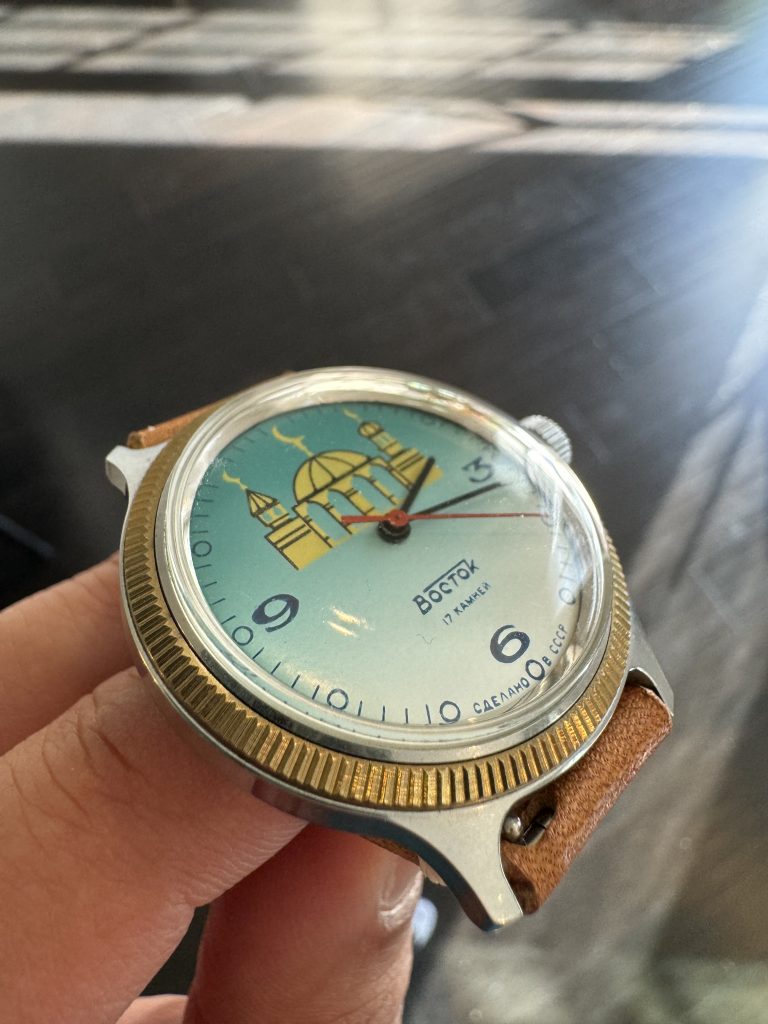
An angled view of my watch. You can see just how domed the acrylic crystal really is.
It was everything a Cold War field watch needed to be: durable and simple, powered by a manual-wind movement; shock-resistant and water-resistant, robust enough for field service rather than life as a desk ornament. And for it’s time, it was highly legible, with bold numerals, luminous hands, and a dial designed to be read at a glance—not admired under a loupe.
On many dials, a single line said it all: “Заказ МО СССР”—Commissioned by the Ministry of Defense of the USSR. That inscription meant that this wasn’t intended to be just a watch, but a piece of equipment, and every scratched crystal, faded bezel, or gouged caseback became a quiet record of service somewhere across the vast geography of the Soviet military—from the Baltic to the Far East, from bases in East Germany to remote garrisons in Central Asia.
By the late 1980s, those guaranteed bulk orders from the Ministry of Defense had begun to dry up. The reforms of perestroika (a series of political and economic restructuring policies introduced by Soviet leader Mikhail Gorbachev in the 1980s) were loosening central control. The military wasn’t buying equipment the way it used to. And Vostok—like many Soviet factories—had to fend for itself.
Where Did It Come From?
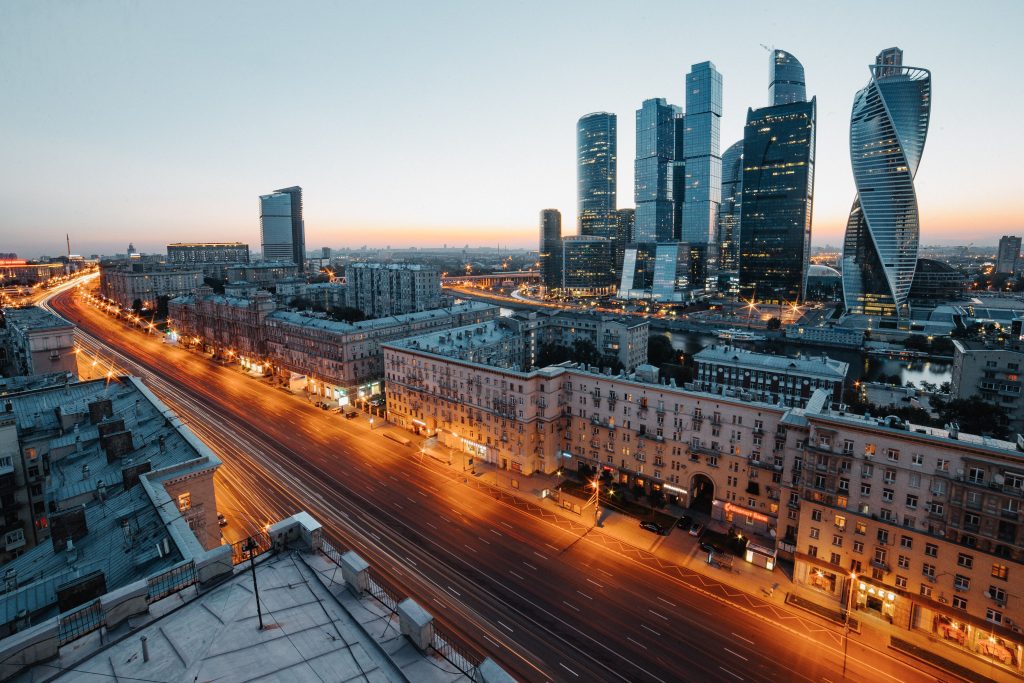
An aerial view of Moscow’s current skyscrapers and urban skyline.
But the Komandirskie’s story doesn’t actually start in Chistopol; it starts in Moscow. It’s a tale of two factories under a single umbrella. In 1930, the Soviet Union founded the First Moscow Watch Factory (1MWF), its first major wristwatch manufacturer. To jumpstart production, the USSR purchased machinery, tooling, and patents from two bankrupt American firms: the Dueber-Hampden Watch Company and the Ansonia Clock Company. Technicians from those companies traveled to Moscow to help set up the lines, and soon the first Soviet mechanical watches rolled out of an assembly line built on repurposed American hardware and Soviet ambition.
Through the 1930s, 1MWF expanded rapidly, producing pocket watches, early wristwatches, and timing instruments for civilians and the Red Army. When the Second World War arrived, the factory pivoted almost entirely to military production: aircraft clocks, artillery timers, naval chronometers, and battle-ready watches.
Then came 1941. As German forces advanced toward Moscow, the Soviet government ordered key factories to evacuate eastward. Part of 1MWF—its people, tools, drawings, and machinery—was sent to a small town on the Kama River: Chistopol, in Tatarstan. It was there that this wartime industrial outpost was established to produce timing equipment for the war effort.
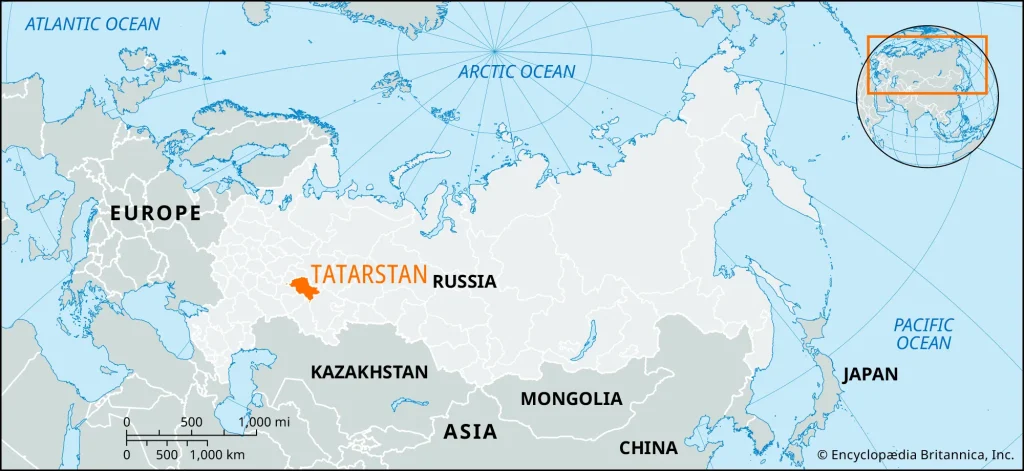
When the war ended, 1MWF re-established full operations in Moscow. The Chistopol branch, however, stayed put, grew roots, and eventually became an independent factory known as the Chistopol Watch Factory. In 1969, it adopted the name collectors know today: Vostok (Восток—“East”).
Over time, their roles diverged. 1MWF, along with the Soviet brand Poljot, emerged as the prestige and technological center of Soviet horology. It produced the Sturmanskie pilot’s watches—like the Strela chronograph worn during the first spacewalk—and advanced movements such as the 3133 chronograph and the 2612 alarm. Its output equipped cosmonauts, air force officers, diplomats, and party elites, placing the factory at the top of the Soviet watchmaking hierarchy.
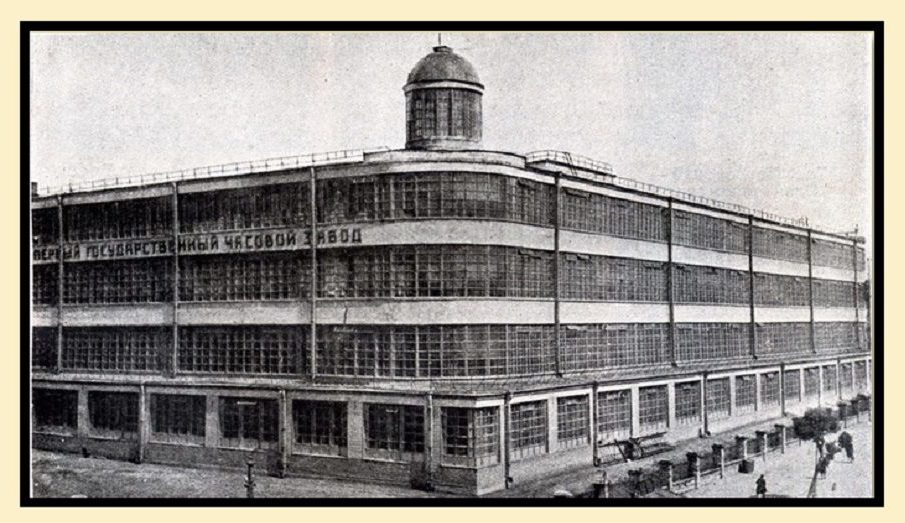
An image of the original 1MWF factory in Moscow (source).
Vostok, by contrast, remained in Chistopol and became the rugged, utilitarian powerhouse of Soviet watchmaking. It served as an official supplier to the Ministry of Defense, created the Komandirskie line for officers, and introduced the Amphibia diver in 1967—a watchmaking-marvel of Soviet engineering built around a flexible caseback and thick acrylic crystal. Above all, Vostok focused on durability, affordability, and sheer production volume.
Side Note: A flexible caseback doesn’t mean that the metal is malleable or moves. Unlike traditional screw-down casebacks that twist and push against a rubber seal, the Vostok deployed a unique two-piece, piston-style assembly. It features an independent metal lid held in place by a separate, threaded outer locking ring. When tightened, the ring presses the lid straight down into a massive, flat rubber gasket without rotating it. Under deep water conditions, this design uses water pressure to its advantage. Instead of resisting the ocean, the independent lid acts like a flexible piston, shifting slightly inward as depth increases. This compression forces the lid harder against the oversized gasket—and works in tandem with a domed acrylic crystal that flattens and expands under pressure—meaning the watch actually seals tighter the deeper it sinks and as water pressure increases.
A Deeper Look At Vostok
The story of Vostok as a company runs in parallel with the story of the state that created it. Born in crisis and shaped by necessity, the factory’s trajectory mirrors the broader arc of Soviet industrial ambition, collapse, and adaptation.
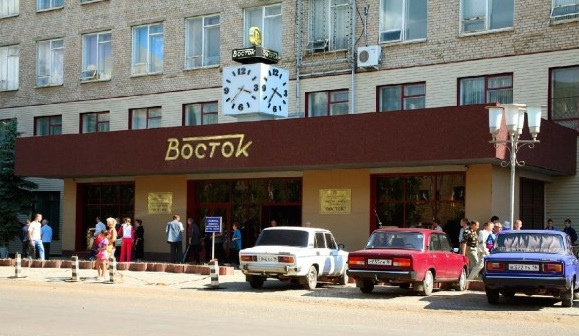
The Vostok Factory in Chistopol.
As I mentioned previously, Vostok’s origins trace back to World War II. Between 1942 and the early 1950s, the Chistopol factory emerged from an evacuated branch of the First Moscow Watch Factory, initially producing timing devices and simple wristwatches under wartime pressure. By the early postwar years, it had begun manufacturing shock-resistant, water-resistant mechanical watches for both civilian and military use, laying the groundwork for its utilitarian identity.
The period from the 1960s through the 1980s marked Vostok’s golden age. In 1965, the factory was named an official supplier to the Ministry of Defense, and the Komandirskie line was formally introduced as a watch for officers. Two years later, in 1967, Vostok unveiled the Amphibia diver, whose unconventional design used water pressure itself to improve sealing at depth—a distinctly Soviet solution to a technical problem. By around 1980, the factory was producing millions of watches annually, many destined for export, making Vostok one of the most prolific mechanical watchmakers in the world.
The 1990s brought upheaval. The collapse of the USSR in 1991 shattered the economic ecosystem Vostok depended on. State orders disappeared, export networks unraveled, and domestic purchasing power collapsed almost overnight. In 1993, Vostok was reorganized as a joint-stock company, entering a decade defined by improvisation. The factory experimented with new product lines, foreign partnerships, and occasional forays into “luxury,” including projects like the Kremlevskie. It was during this period of uncertainty that rarer and more eccentric dials—such as my mosque variant—began to appear, artifacts of a factory trying to survive by adapting rather than planning.

The watch assembly line at the Chistopol factory.
Through the 2000s and 2010s, Vostok endured financial strain and even brushes with bankruptcy. Some of its machinery and movements found new life elsewhere, including in brands like Vostok Europe, a separate Lithuanian company that uses Vostok movements. Yet the original factory in Chistopol survived restructuring and continued to produce mechanical Komandirskie and Amphibia watches, earning a global cult following that valued their durability, idiosyncrasies, and unmistakably Soviet character.
Today, Vostok occupies a niche that would likely have baffled its original planners. It is beloved by watch enthusiasts worldwide as a source of affordable, quirky, over-engineered mechanical watches with a distinctly Soviet flavor. Movements like the 2414A and the 2416B automatic have become workhorses in modding communities, while surviving Soviet-era pieces marked “Заказ МО СССР,” early Amphibias, and rare regional or symbolic dials—like the mosque—have become minor grails among collectors of Eastern Bloc horology.
By contrast, the prestigious parent did not endure. The First Moscow Watch Factory, later associated with Poljot, struggled through the post-Soviet 1990s and ceased watch production around 2004. Portions of its machinery were acquired by companies such as MakTime, which continued producing the celebrated Poljot 3133 chronograph movement until about 2011, while historic names like Sturmanskie, Aviator, and Buran were revived by new firms such as Volmax. Today, there is no single, unified Poljot factory; the name survives in licensed and disputed forms, while the original 1MWF buildings have largely been repurposed.
This is a cool link from the Russian Times with a more detailed timeline of Vostok.
Vostok—the wartime child—outlived its parent.
Which means that my mosque-dial Komandirskie doesn’t merely sit at the end of the Soviet timeline. It occupies a hinge point in the industrial history of Russian watchmaking, poised between a world where time was centrally planned and one where survival depended on adaptation, improvisation, and a willingness to let new symbols quietly take root.
The Greater Importance of Vostok
There’s another layer to the word Vostok that deepens the symbolism of this little mosque. For most watch collectors, “Vostok” immediately conjures the Chistopol factory. But in the 1960s, Vostok was also the name of something else entirely: The Soviet Union’s first crewed space program.


Left: Vostok rocket exhibited at night, in Moscow. Right: The Monument to the Conquerors of Space in Moscow.
On April 12, 1961, a 27-year-old pilot named Yuri Alekseyevich Gagarin climbed into a small spherical capsule perched atop a Vostok-K rocket at the Baikonur Cosmodrome. At 09:07 Moscow time, the engines roared to life. As the rocket lifted, Gagarin uttered a word that became legend: Poyekhali! — “Let’s go!”
The mission—Vostok 1—lasted 108 minutes. Gagarin completed a single orbit of the Earth, encased in a pressurized cabin with the spacecraft’s systems largely automated. During re-entry, he ejected from the capsule and parachuted into the fields of Saratov Oblast, landing near a farmer and her daughter.
“I am a Soviet citizen, Yuri Gagarin. I have come from space,” he reportedly told them.
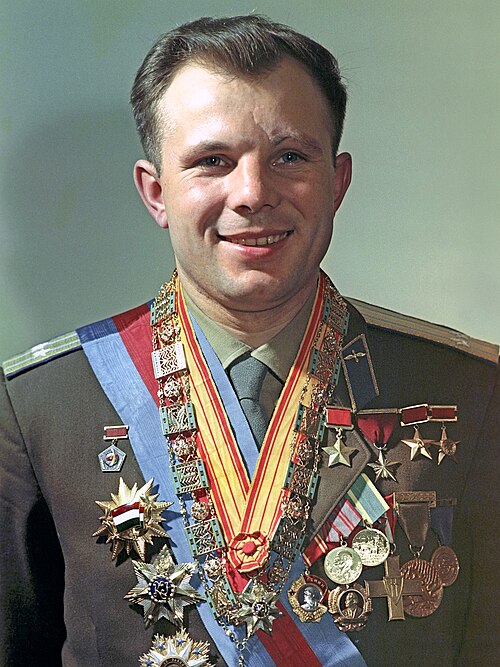
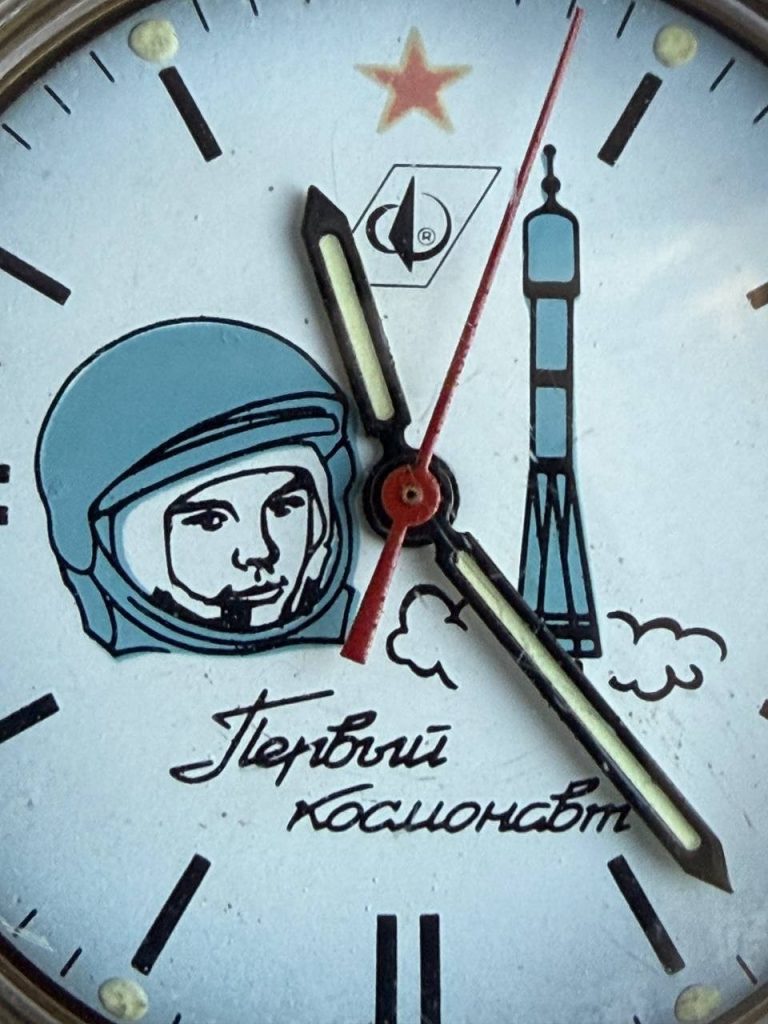
Left: Cosmonaut Yuri Alekseyevich Gagarin. Right: A Vostok 2414 with a dial commemorating Gagrin.
On his wrist during the entire journey was not a Swiss chronograph or a space-rated prototype, but a domestic military-issue watch: a Sturmanskie (“Navigator’s”) pilot’s watch made by the First Moscow Watch Factory.
This modest 15-jewel, manual-wind watch—about 33 millimeters in diameter, with an acrylic crystal and leather strap—became the first wristwatch in space. It wasn’t advertised, marketed, or sold in boutiques. It wasn’t even available to civilians. Sturmanskie watches were issued exclusively to Soviet Air Force pilots upon graduation.
The watch survived the mission because it didn’t have to do anything spectacular. The cabin remained pressurized; the forces involved were well within what a military pilot’s watch could endure. Gagarin’s Sturmanskie did what watches do: it kept time.
That watch—now preserved in the Gagarin family collection—has come to embody the prestige arc of Soviet horology: from American-tooled origins at 1MWF, through wartime production, to the symbolic summit of spaceflight.
Meanwhile, back in Chistopol, the wartime child factory was building a different legacy—one of rugged, uncelebrated endurance. Komandirskie for commanders. Amphibia for divers. Millions of mechanical watches for soldiers and citizens across the USSR.
If Sturmanskie represented Soviet horology at its most exalted, then Vostok represented it at its most enduring.
Back To the 1980s
In the late 1980s, Vostok was operating in a strange in-between. It still had the legacy and tooling of a state military supplier, but no longer had the same reliable state orders. The factory had to look outward: export markets, regional buyers, and anyone willing to pay for mechanical watches in an economy hurtling toward crisis.
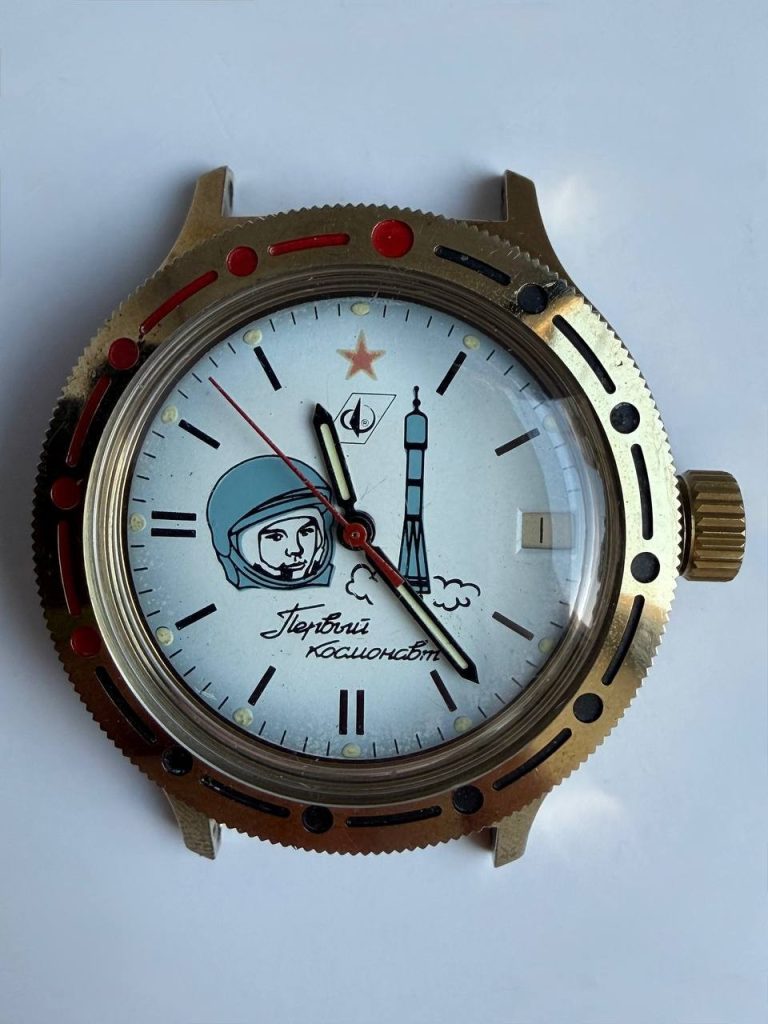
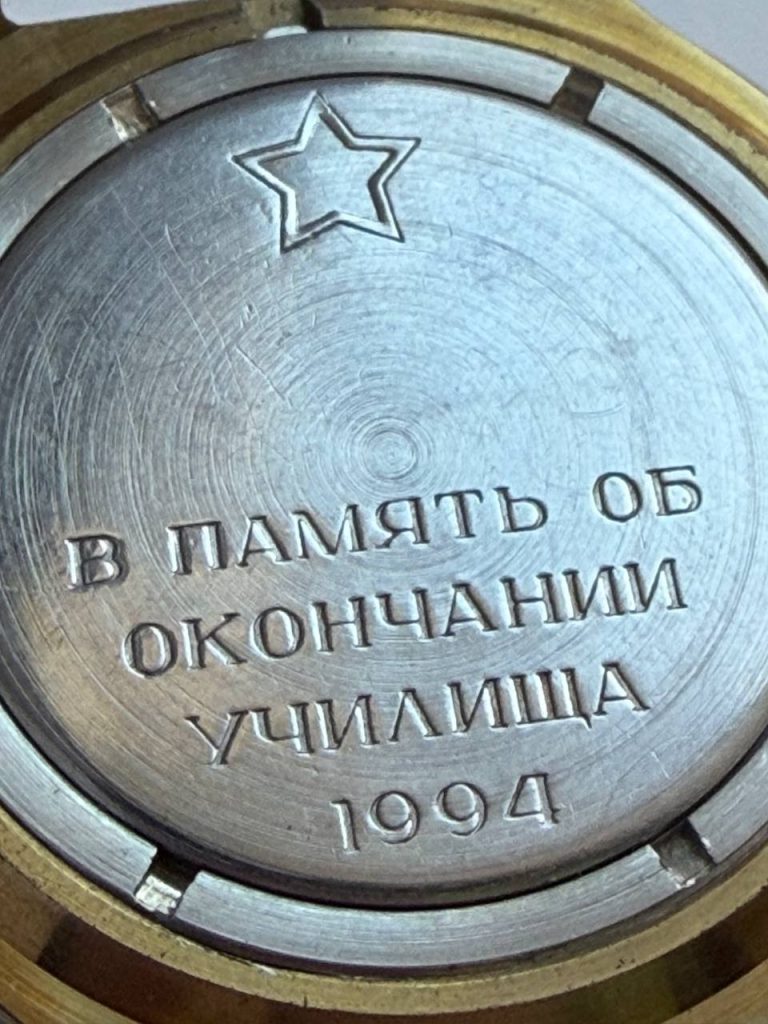
Front and back shots of a Vostok 2414 commemorating Cosmonaut Gagrin.
The factory responded by widening its catalog accordingly. Out went the strict diet of military-inspired hardware, and in came a quiet menagerie of new dials—flags, commemorative symbols, animals, regional motifs. Somewhere in that liminal space between central planning and capitalism, the first mosque dial appeared.
Which brings me to the watch that started all of this. The design is striking in its simplicity: a golden dome rendered in clean, deliberate geometry, flanked by minarets rising on either side—stylized, yet unmistakable. The dial field, often blue or silver, evokes sky more than stone.
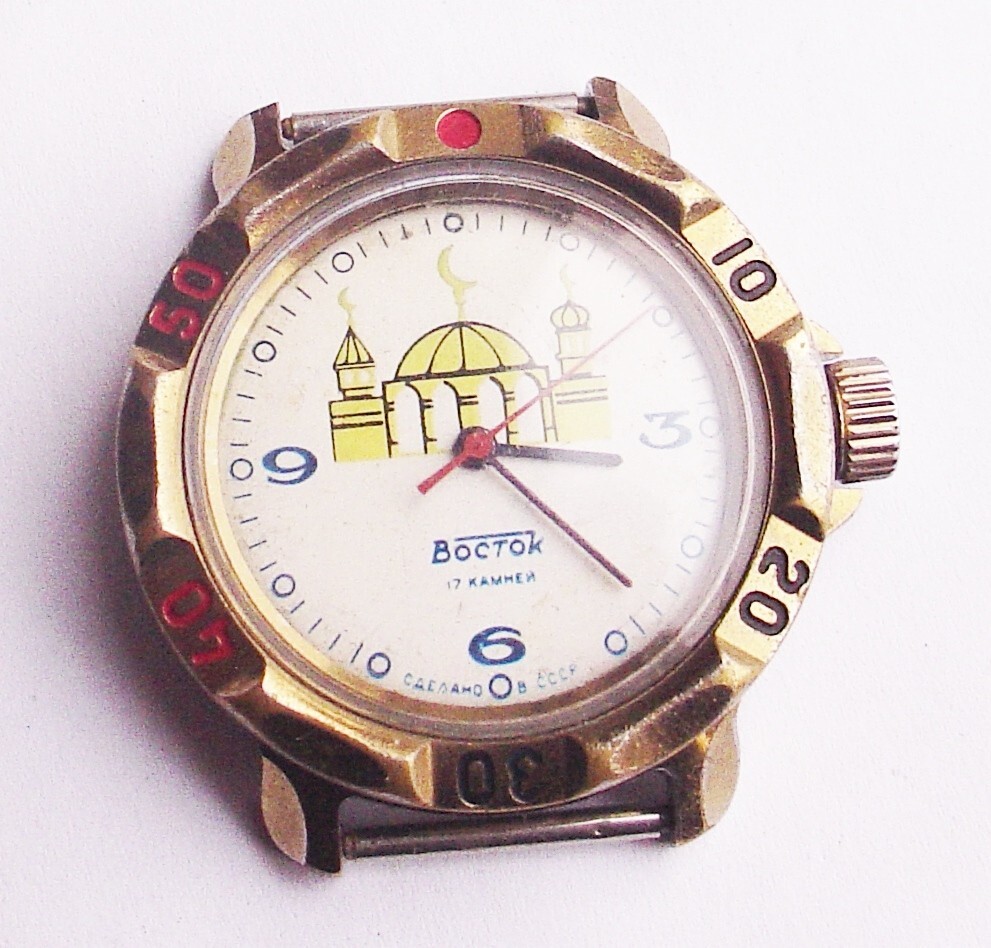
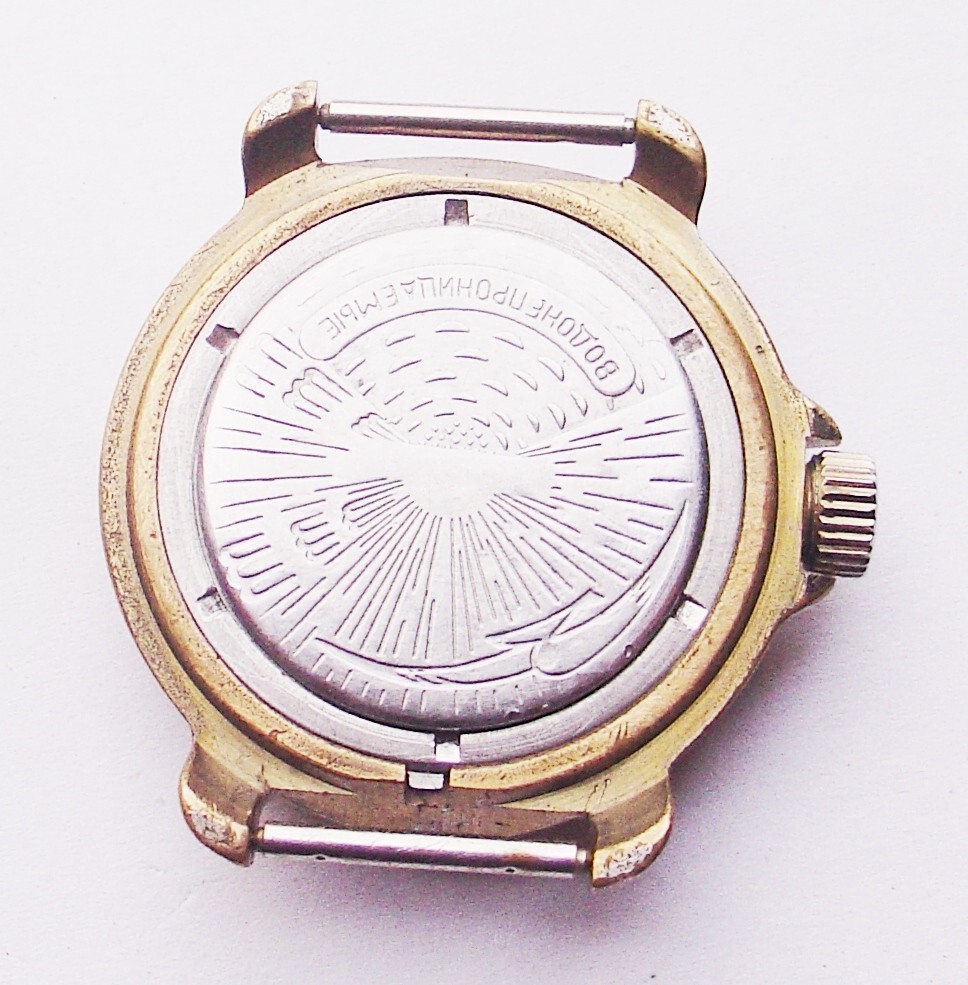
Another example of a Vostok Komandirskie, featuring the same Yellow Mosque dial, but a different case.
This wasn’t the only one, however. Further research—more eBay trolling—revealed a few different mosque-inspired dials, including one depicting the Grand Mosque in Makkah, Saudi Arabia. But the origins of this line remain a mystery. Were these state-approved designs? A regional tribute to Tatarstan’s Muslim heritage? A quiet nod by local designers and factory workers to the religious identity all around them? Or something even more pragmatic—an unofficial run intended to sell quickly in nearby Muslim-majority markets?
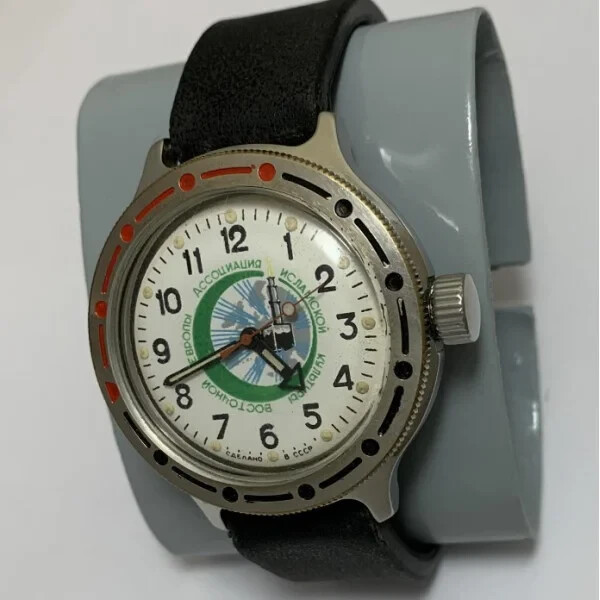
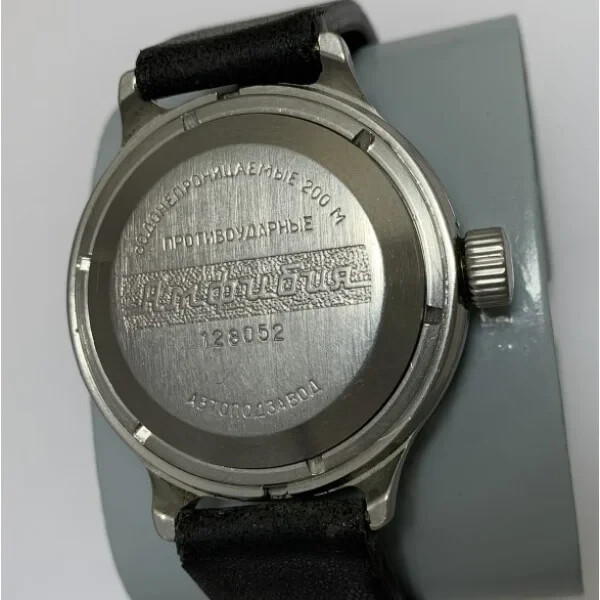
A stunning example of a Vostok Komandirskie, featuring an image of the Grand Mosque in Makkah, Saudi Arabia.
No definitive records survive. Collectors and historians have their theories. Some see the dial as a generic Islamic motif, while others attempt to anchor it to a specific structure. In Tatarstan, two names surface most often: the Kul Sharif Mosque in Kazan—destroyed by Ivan the Terrible in 1552 and later resurrected in monumental, multi-minaret form in the post-Soviet era—and the older Märcani Mosque, a symbol of centuries-old Tatar Islam and one of the few mosques permitted to function even through the harshest Soviet years.
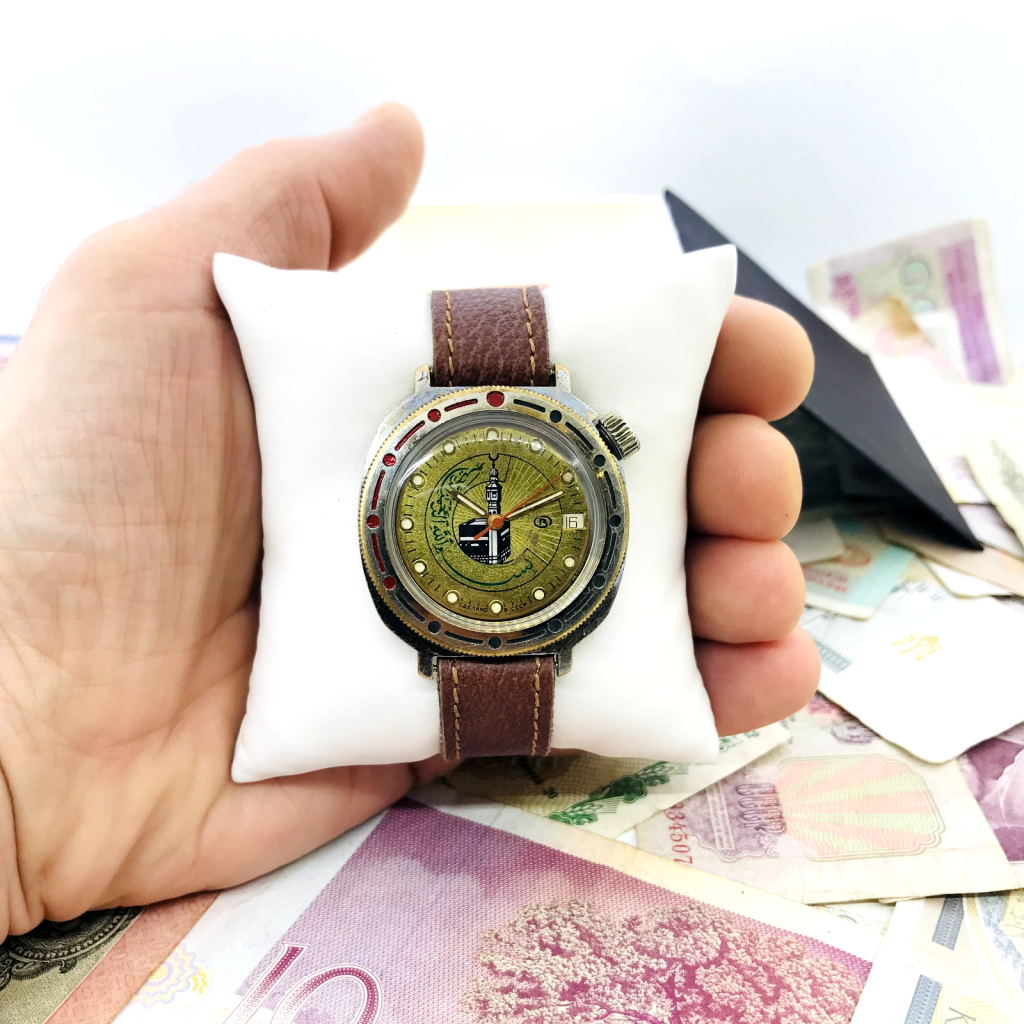
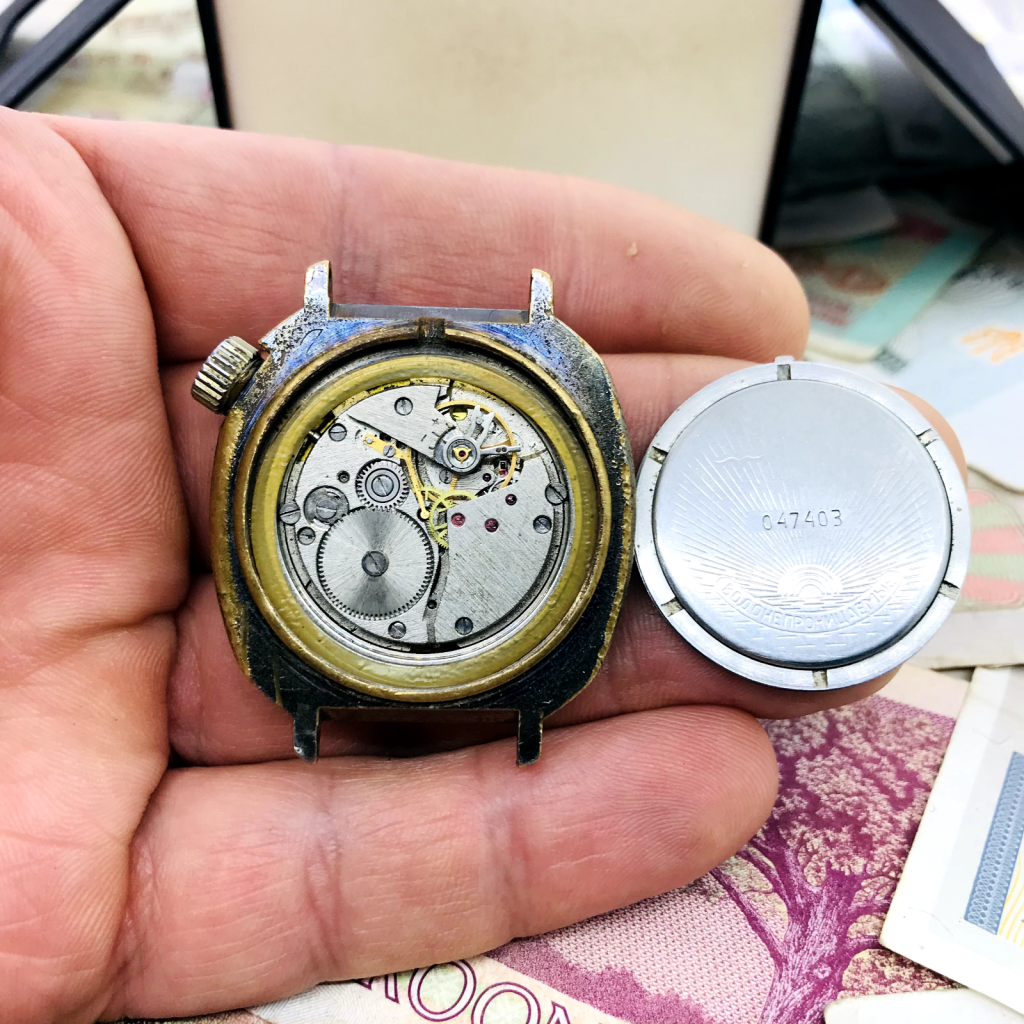
Another example of a Vostok Komandirskie, featuring an image of the Grand Mosque in Makkah, Saudi Arabia.
Whether the dial was meant to depict one of these or simply capture “a mosque,” the tension is perceivable. To wear this watch in 1990 was to strap a contradiction to your wrist: a Soviet officer’s watch bearing a symbol of Islam, in a state that had officially discouraged religious practice for most of its existence.
In other words, mechanically and structurally this is just another Komandirskie. Beneath the golden dome, the word “Boctok” still sits confidently across the dial. The same name issued to countless Soviet officers.
Islam Before, During and After the USSR
But of all things, where does a mosque fit into this picture? Islam and the USSR are rarely spoken of in the same breath—certainly not in pop culture or industrial design, and especially not in a way you would expect to find illustrated on the dial of a military watch.
Curious, I dug deeper, and what I found completely reframed the question. Islamic tradition in the region stretches back more than a thousand years, long predating the Soviet state itself. What initially seemed like an anomaly began to look less like a contradiction and more like a quiet acknowledgment of a history that never fully disappeared.
Islam first arrived in the lands that would later become part of Russia between the 7th and 10th centuries, carried by Arab traders and armies into the Caucasus. The city of Derbent emerged as one of the earliest Islamic centers in what is now Russian territory, while Turkic peoples across Central Asia gradually adopted the faith.
In 922 CE, the Volga Bulgars—whose kingdom occupied much of modern-day Tatarstan—formally converted to Islam. This moment became the spiritual foundation of Islam within today’s Russian Federation, anchoring the faith deeply in the Volga region centuries before Moscow’s rise.
During the 13th through 15th centuries, the Mongol-Tatar era reshaped the political landscape. The Golden Horde embraced Islam, and for generations Muslim khanates governed vast stretches of territory that would later be absorbed into the Russian state.
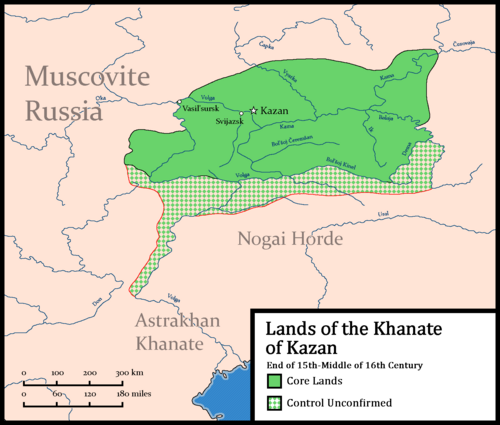
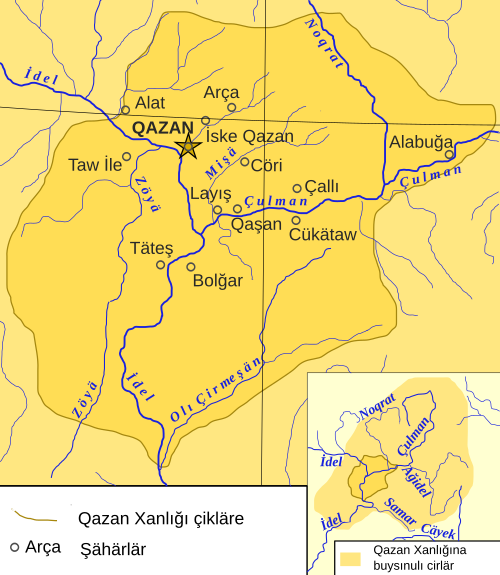
Left: The Khanate of Kazan, c. 1500–1550. Right: A map of the Kazan Khanate from the 1540s. (source)
And then came the rise of Moscow and the balance shifted dramatically in 1552, when Ivan the Terrible conquered the Kazan Khanate and destroyed its main mosque. With that act, Moscow’s rule over long-established Muslim populations began—a relationship marked by domination, resistance, and uneasy coexistence.
Throughout the 18th and 19th centuries, as the Russian Empire expanded into Muslim-majority lands across the Volga region, the Caucasus, Siberia, and Central Asia, it oscillated between repression and accommodation. Catherine the Great formally recognized Islamic institutions even as imperial forces waged prolonged and brutal wars against Chechen and Dagestani resistance. The state created bodies such as the Orenburg Muslim Spiritual Assembly to manage—and contain—religious life, while imperial campaigns in Central Asia brought millions more Muslims under Russian rule, including Uzbeks, Tajiks, Kazakhs, Kyrgyz, and Turkmen.
By 1917, Muslims made up roughly 10–15% of the empire’s population and then came the Soviet era. In the early years after the revolution, there was a surprising degree of cultural experimentation and minority recognition. By the 1930s, however, Stalin’s purges closed thousands of mosques, executed or exiled imams, and banned religious education. A few showcase mosques remained open under tight control, but most religious life retreated into private homes and remote villages. Yet Islam endured—quietly, privately, and within tightly controlled “Spiritual Boards” that allowed just enough visibility for survival.

An illustration of Tatar soldiers of the time (source)
It endured in Tatarstan and Bashkortostan, in Dagestan and Chechnya, in Uzbek and Tajik mountain valleys, in Kazakh and Kyrgyz towns. It survived in whispers and kitchen Qur’an lessons and carefully maintained cemeteries. It survived under portraits of Lenin and beneath red flags, through decades when religion could cost you a career or worse.
By the time my Komandirskie was assembled around 1990, the Soviet Union had entered its final chapter. Mosques that had been shuttered were beginning to reopen. New ones were being built. Old forms of devotion were stepping cautiously back into public life after decades in the shadows. After 1991, with the collapse of the Soviet Union, a dramatic Islamic revival unfolded. Thousands of mosques were reopened or rebuilt. Kul Sharif rose again in Kazan, and grand mosques appeared in Grozny, Makhachkala, and across Central Asia. Islam reclaimed its place not as a foreign intrusion, but as one of the region’s oldest and most enduring identities.
And in that factory in Chistopol—a town in Tatarstan, a seat of Islam in Russia, on the banks of the Kama River—that once supplied the Red Army with its official commander’s watches, someone printed a mosque on a dial. Seen through this lens, the mosque on a Komandirskie dial no longer feels inexplicable. It feels inevitable.
The Mosque on the Dial
The mosque on my watch is small enough to disappear beneath a thumb, yet the architectural imagination it evokes is vast. While we don’t know which specific structures inspired these dials, certain mosques across the former Soviet and Soviet-adjacent world have taken on iconic status—markers of identity, memory, and resilience. Together, they help explain why such a symbol could quietly surface on a Komandirskie.


The majestic Kul Sharif Mosque with it’s intricate domes and minarets in Kazan, Russia.
In Tatarstan, the rebuilt Kul Sharif Mosque stands as perhaps the most powerful example. Destroyed in 1552 during Ivan the Terrible’s conquest of Kazan, it was resurrected after 1991 as a vast, luminous complex within the Kazan Kremlin. Its multiple minarets and blue domes are a deliberate statement: Tatar Islam did not vanish—it endured, waiting for a moment to reappear. Farther south, in Chechnya, the Akhmad Kadyrov Mosque, often called the “Heart of Chechnya,” dominates the skyline. Built in an Ottoman style and capable of holding thousands of worshippers, it rises from a city that was destroyed and rebuilt, forming part of a carefully curated narrative of revival, memory, and state power.
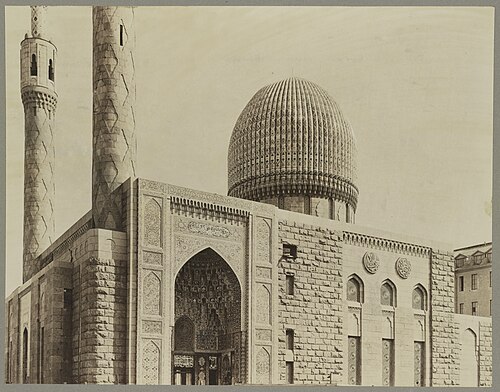
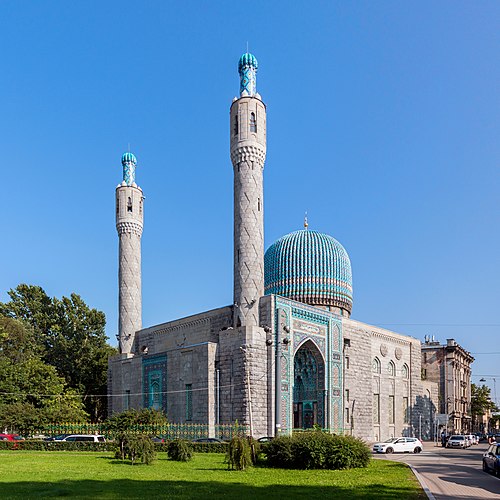
Left: The Saint Petersburg Mosque in 1917. Right: The Mosque as it stands today. (source)
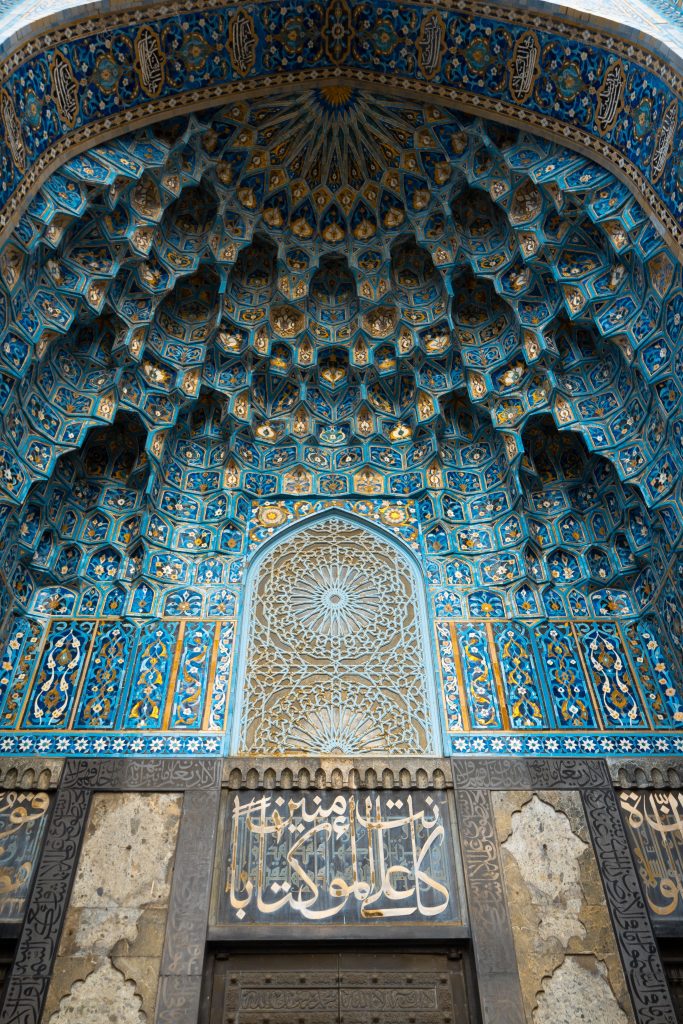
A detailed view of the ornate archway inside the Sankt-Peterburgskaya Sobornaya Mechet (Saint Petersburg Mosque) displaying exquisite Islamic artistry.
In Russia’s former imperial capital, the Sankt-Peterburgskaya Sobornaya Mechet (Saint Petersburg Mosque) tells a different story. Constructed between 1910 and 1920, it was once the largest mosque in Europe. Its turquoise dome and ornate portals sit just blocks from the Neva River—a slice of Central Asian and Persian aesthetic transplanted into the heart of a non-Muslim imperial city. In the foothills of the Caucasus, the Mukhtarov Mosque offers yet another expression. Built between 1900 and 1908 by Azerbaijani oil magnate Murtuza Mukhtarov, its Mamluk-inspired design—echoing Cairo landmarks like Al-Azhar—rises dramatically against the surrounding landscape, a reminder of the region’s layered cultural exchanges.

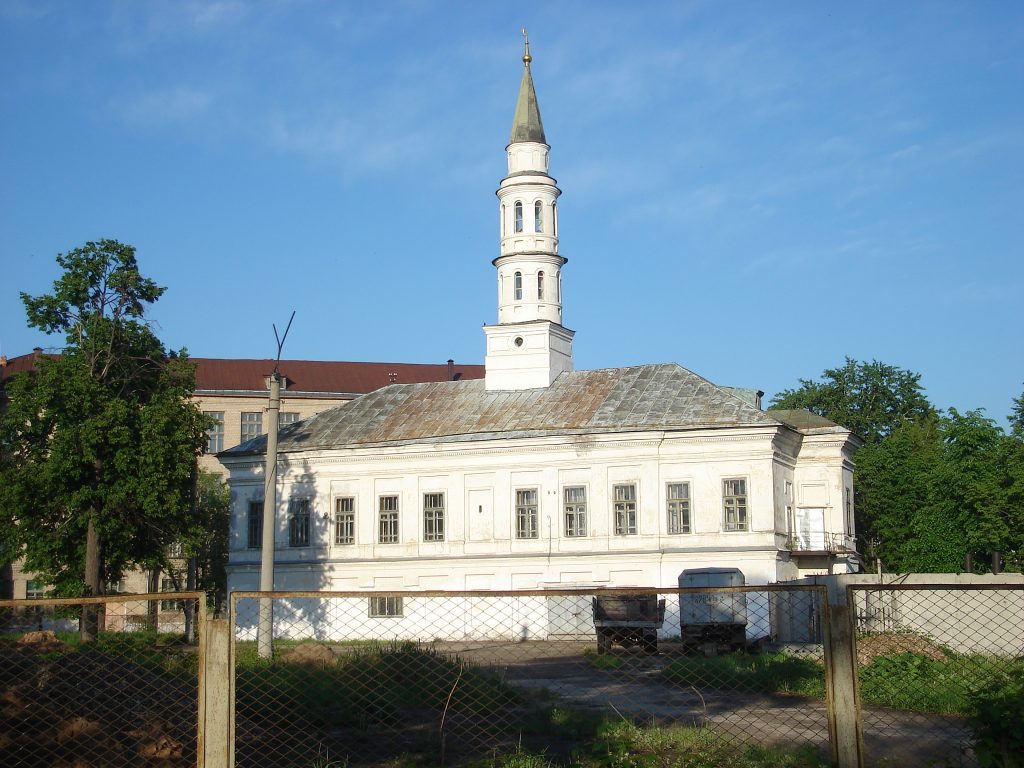
Left: The Nizhnyaya Bereske Mosque was originally constructed in 1769 which was initiated by Ibrahim Burnaev (source).
Right: According to the old legend, İske Taş (“Old Stone”) Mosque was built in 1802, on the place of a communal grave of the men who defended Kazan in 1552. The grave was marked by a big old stone (zur iske taş), which was preserved in front of the east facade of the mosque for many years after its construction. (source)
Closer to the ground in Tatarstan are historic local mosques such as the İske Taş (“Old Stone”) Mosque and the Nizhnyaya Bereske Mosque. These structures survived imperial rule and Soviet closures in various broken, altered, and restored forms. Some incorporate elements of Russian Baroque or local vernacular styles, proof that Islamic architecture in the region has never been monolithic, but adaptive and hybrid, shaped by circumstance as much as faith.

The beautifully adorned exterior walls of The Painted Mosque or Šarena Džamija. (source)
Step just slightly beyond the borders of the former USSR and the architectural imagination widens further. The Painted Mosque (Šarena Džamija) stands out as a singular landmark, its walls and interior surfaces covered in vivid, almost textile-like painted patterns and botanical motifs. It demonstrates that iconic need not mean monumental mass alone—it can also emerge through artistic daring and local expression.

A shot from the interior of the Šarena Džamija. (source)
In this context, iconic takes on multiple meanings: monumental scale and skyline dominance, as in Kazan or Grozny; a unique artistic program, as in Tetovo; survival and restoration after oppression, as seen across Tatarstan and Central Asia; or simple visibility—the presence of a minority faith made unmistakable in a major non-Muslim city like Saint Petersburg.
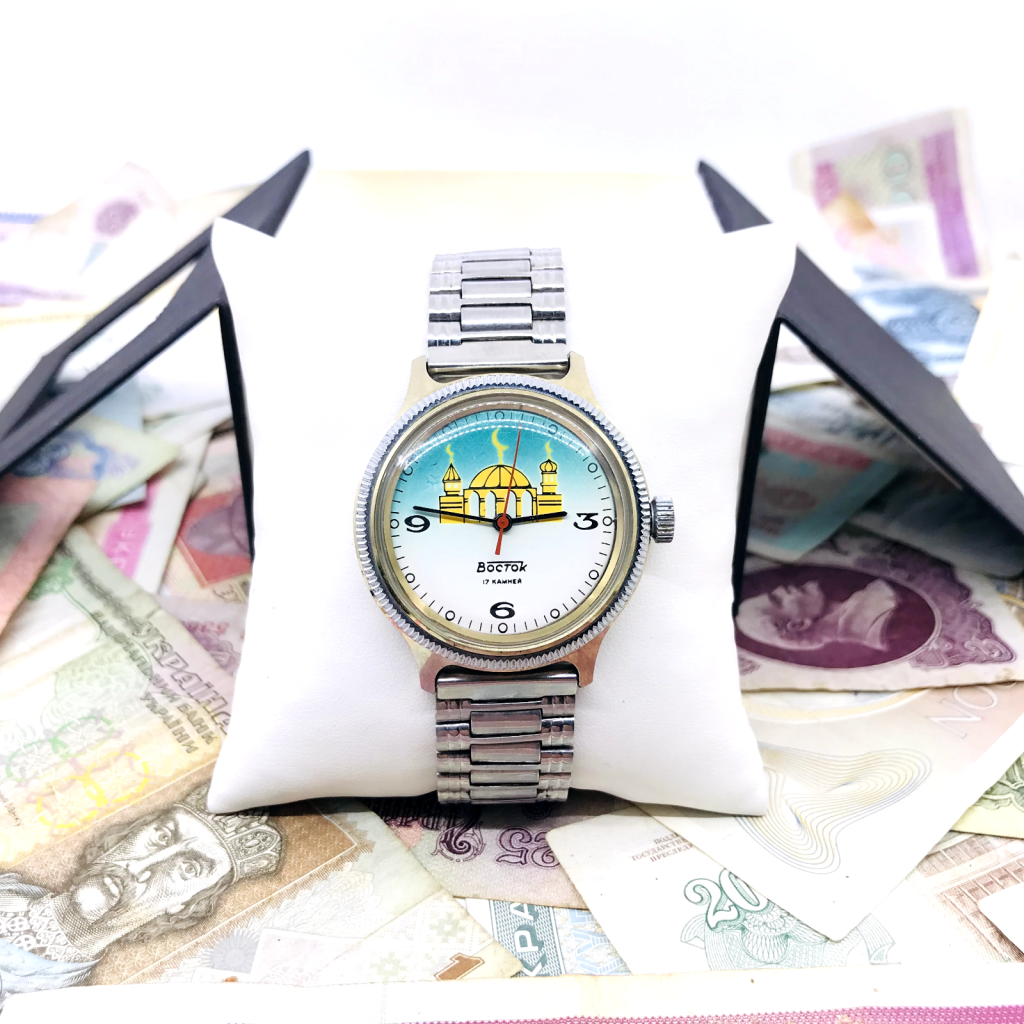
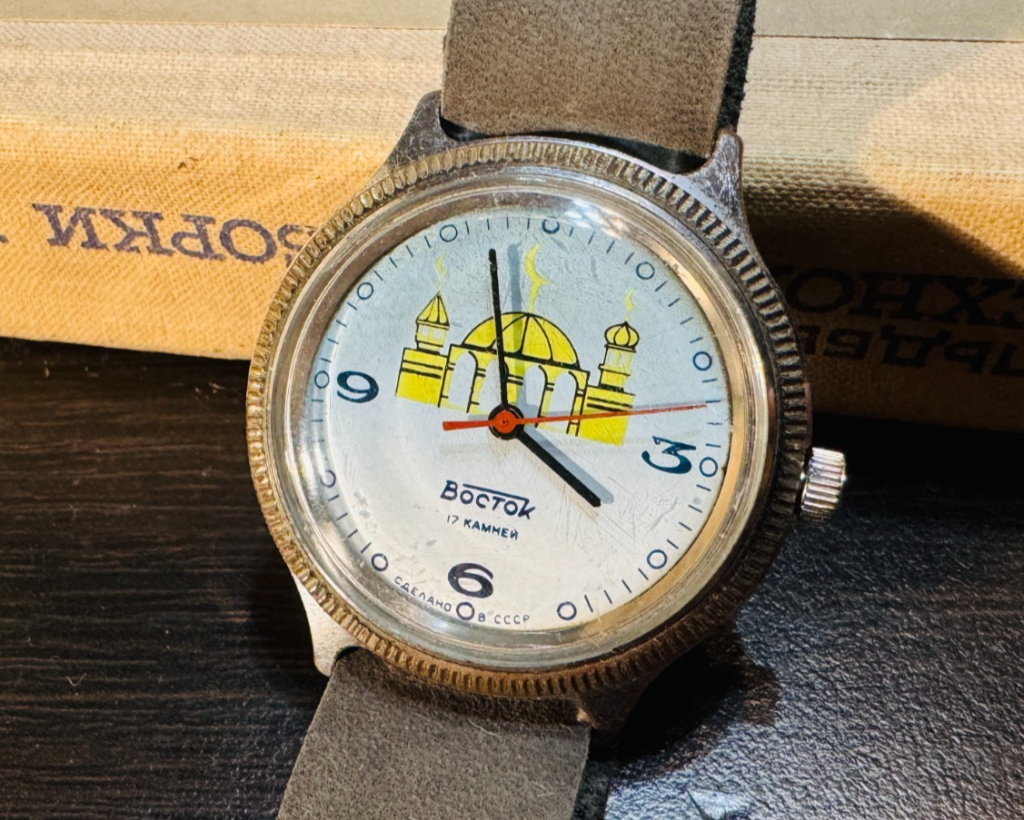
The mosque on my Komandirskie is not a copy of any one of these structures. It is more symbol than portrait, more idea than blueprint. Yet viewed against this history, that tiny golden dome begins to feel like a condensed skyline—a wrist-sized echo of domes and minarets scattered from Kazan to Grozny to Derbent. The Soviets built entire cities around the control of time and production. Here, on a watch born of that system, the dial quietly insists that other temporalities exist—ones structured not by factory sirens, but by prayer times threading through five fixed moments of the day, rhythms no regime ever fully managed to overwrite.
So What Exactly Am I Wearing On My Wrist?
On one level, it’s just a mechanical object. A manual-wind movement that needs 20–30 turns of the crown, a chrome-plated case that has seen better days, a slightly cloudy acrylic crystal that catches light in a way sapphire never will. It gains or loses a modest number of seconds per day. It ticks audibly if you hold it to your ear.

But layered over all of this is a palimpsest (big word! 🤓) of symbols. The Komandirskie name and its military heritage mark it as a watch meant for officers—for those who issued orders or carried them out—a companion to uniforms and documents stamped with red seals. The Vostok logo serves as a reminder of a factory born from wartime evacuation, a descendant of 1MWF that grew into the USSR’s great utilitarian watchmaker, and a brand that survived where so many others did not. The Cyrillic inscription “Сделано в СССР” acts as a quiet time capsule, declaring Made in the USSR even though the state it names no longer exists. And at the center sits the mosque: a small, stylized dome flanked by minarets, calling back to more than a thousand years of Islam in those lands—from the Volga Bulgars’ conversion in 922, through underground prayer circles in Soviet apartments, to the Islamic revival after 1991.
At the moment this watch was assembled, every one of those layers was in flux. The Soviet Union was on the brink of dissolution, and the factories that had served it were scrambling to imagine a future beyond the state that had sustained them. Islam, long suppressed, was returning openly to the streets, skylines, and soundscapes of cities like Kazan, Ufa, Grozny, and Makhachkala, as well as countless towns across Central Asia. Colonial-era borders were being redrawn as former Soviet republics stepped into independence.
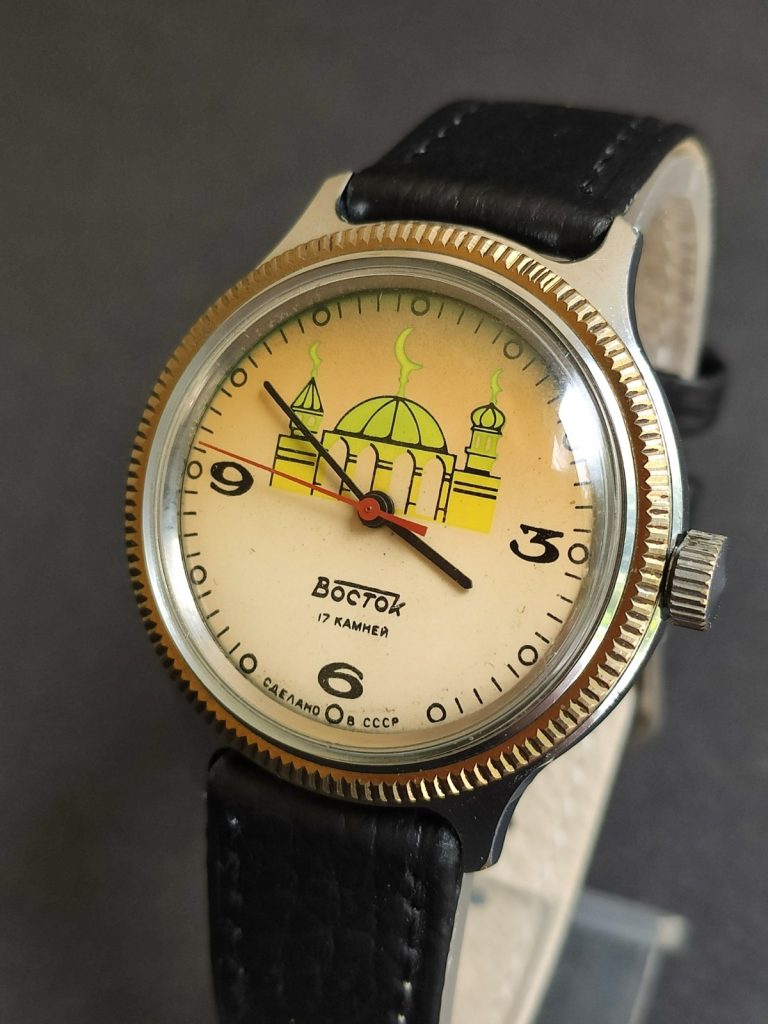
Seen from that vantage point, a mosque on a Komandirskie dial is no mere oddity. It becomes a wrist-sized metaphor for the afterlife of symbols: a military watch that once marked duty now quietly marking devotion; a Soviet brand name—Vostok—that once proclaimed the East’s challenge to the West now living on through collector communities and YouTube mod videos; and Islamic architecture that outlasted empires and regimes reappearing not as monumental domes, but as a tiny printed motif on a 39-millimeter dial.
And now, three decades later, mosque-dial Komandirskies appear occasionally in collector forums and vintage listings. Some call them “Islamic Komandirskies.” Others dismiss them as regional curiosities or aftermarket oddities. Whatever their precise origin story, they stand as artifacts of transition—objects from a moment when ideology loosened just enough for identity to seep visibly back through the cracks.
When I pick it up, wind the crown, and feel the mainspring tighten, I’m not just starting the gear train. I’m reviving a particular moment in history: the late Soviet convergence of faith, machinery, and uncertainty.
Every Watch Tells Time. But Some Watches Tell History.
This Komandirskie is one of those. Wind it, and you’re not just energizing a 2414A movement; you’re setting in motion stories that stretch from American bankrupt factories in the 1930s, to wartime evacuations and the birth of Vostok, to Yuri Gagarin’s Sturmanskie circling the globe, to mosques shut and reopened across a continent, to a collapsing union in 1990 where factory workers in Chistopol kept doing what they knew: assembling watches.
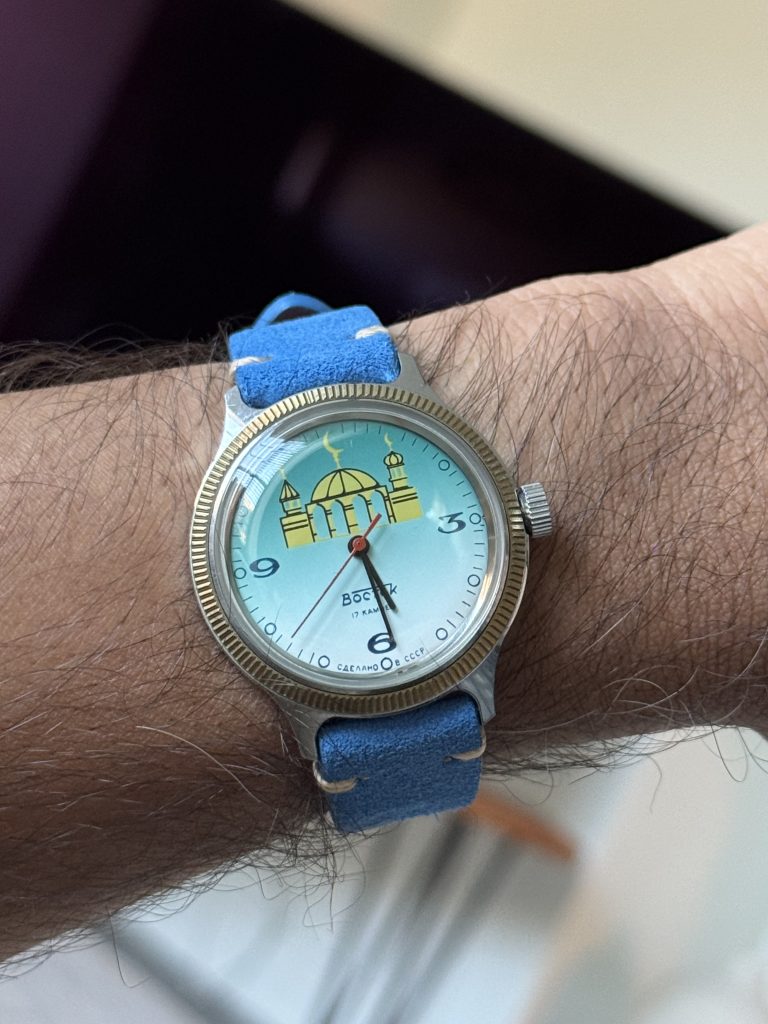
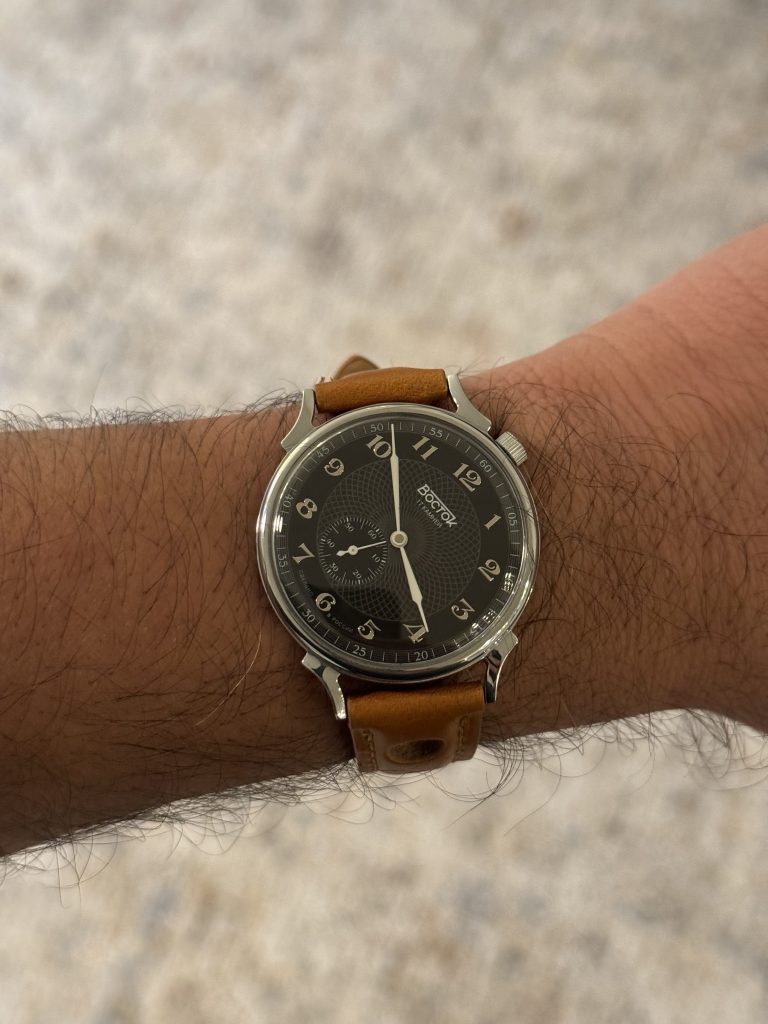
Left: My Vostok Komandirskie, currently being worn on a blue suede strap (it really makes the color of the dial pop! 🤗) Right: Another one of my Vostoks, a canted-dial Prestige model (I’ll write about this one soon! 🙃)
On a purely technical level, there is nothing miraculous about it. It’s not rare because of a complication, or because a celebrity wore it, or because a luxury brand says you should care. It’s rare because someone, somewhere, decided to let a mosque share space with the Soviet star on a commander’s watch—and because not many of those dials survived intact into the present.
All of that is there, condensed into steel, brass, acrylic, and ink.
On most days, when I wear it, the watch just does what watches do: it gets scuffed on doorframes, fogs slightly on a rainy day if I’m careless, slips under a cuff during meetings. But every now and then, I catch the light glancing off that little yellow dome, and I remember:
This isn’t only a watch with a mosque on it. It’s a three hands moving forward—long after the empire that made them is gone.
🫡
⏱🕌☭ ⏱🕌☭ ⏱🕌☭ ⏱🕌☭ ⏱🕌☭ ⏱🕌☭⏱
Every watch has a story behind it (some of them going back centuries)! Find more at 👉 bowearswatches.com