A story of memory, movement and meaning from the beating heart of Pakistan’s textile capital.
Lately, I’ve found myself writing a lot about clock towers. More than I planned to. It’s not just their charm, their age, or their photogenic symmetry, it’s what they mean. These towers aren’t just instruments of time—they’re cultural anchors.
Civic symbols. Quiet witnesses to everything from empire to independence, from morning markets to midnight marches. They don’t just mark the hour; they stand in silent testimony.
Whenever I travel, I make a point to find the local clock tower. Not just to photograph it, but to stand still in its shadow—to listen for what stories it might tell, if it could chime them out. These towers don’t just mark the hour. They hold history. They keep memory.


It’s been many years since I last visited Faisalabad. But Ghanta Ghar. (which literally means Clock Tower), the city’s iconic Clock Tower, has never really left my mind. It’s one of those places that sits at the intersection of architecture and identity. And while I haven’t been back in person, I want to bring you back with me in words.
Constructed during the British Raj and completed in 1905, the tower is more than just an architectural landmark, it is the symbolic and geographic nucleus of one of Pakistan’s most industrious cities.
A Timepiece of Empire
Ghanta Ghar was commissioned under the rule of Sir Charles Rivaz, the British Lieutenant Governor of Punjab, and built with local funding provided by landowners at a rate of 18 Rs./sq. “units” of land. I use the word unit here because I couldn’t find much more information during my research. Most of the sources available online contained the following typo: “…Rs. 18 per square of land…”.

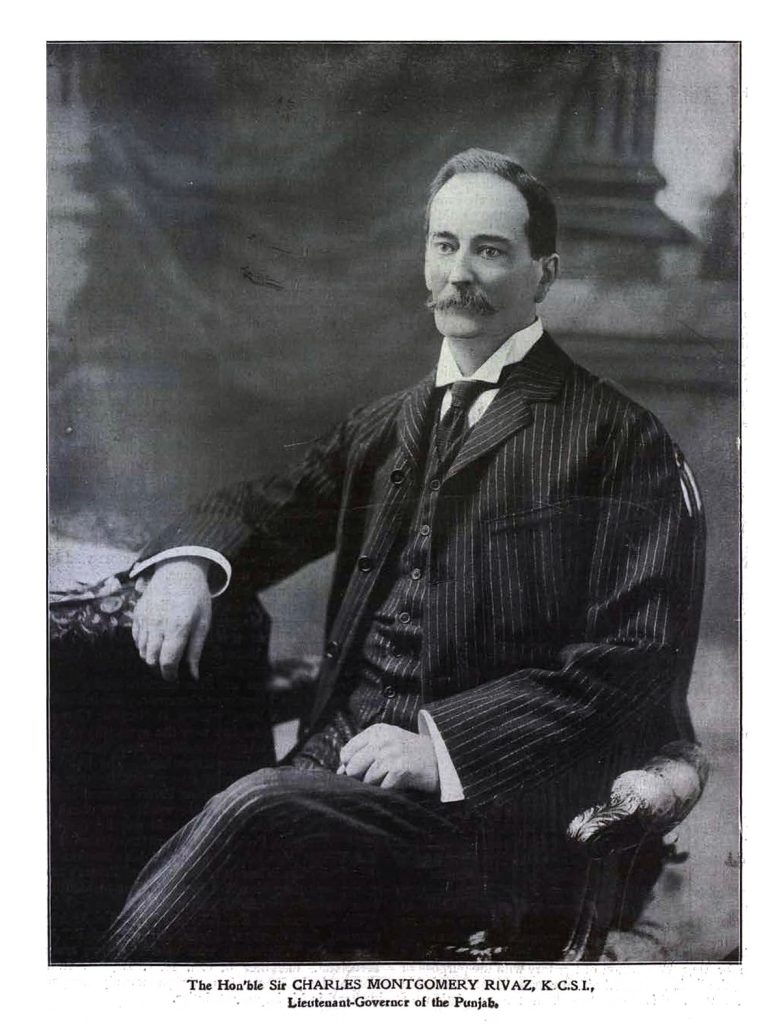
Sir James Lyall, after whom Lyallpur was named (left), Sir Charles Montgomery Rivaz, Lieutenant Governor of Punjab from 1902-1907 (right)
Laid atop a filled-in well, the tower was designed in the Indo-Saracenic style, with red sandstone brought from Sangla Hill and intricate craftsmanship provided by artisans reputedly related to the builders of the Taj Mahal. It was intended as a commemorative structure for Queen Victoria, with inscriptions in English, Urdu, Hindi, and Gurmukhi, a nod to the pluralistic fabric of the time.
The Indo-Saracenic style, also known as Indo-Gothic or Indo-Islamic Revival, emerged in British India during the late 19th century as a fusion of local and imperial architectural traditions. It blended Mughal, Rajput, and Sultanate elements with European styles like Victorian Gothic and Neoclassicism. The result was a grand, ornamental aesthetic marked by domes, minarets, cusped arches, chhatris (domed kiosks), and jali (latticed stone screens), often crafted from red sandstone or marble.
British colonial architects used this style in public buildings like railway stations, clock towers, museums, and courts as a way to project imperial authority while incorporating the visual language of the subcontinent. In many ways, Indo-Saracenic architecture was an act of architectural diplomacy—meant to impress, assimilate, and govern, all at once. Ghanta Ghar is a classic example of this style. It’s a colonial monument built to commemorate Queen Victoria, yet draped in the stylistic signatures of its locale.
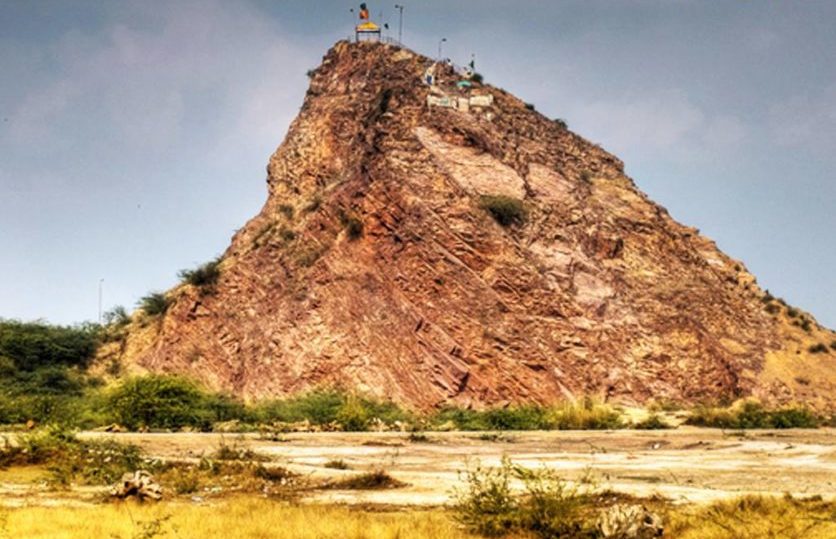

Sangla Hill, the source of Ghanta Ghar’s iconic red sandstone and also the site of the Sangla Hill Fort built by Emperor Akbar in the late 16th century (left); The Faisalabad Railway Station, established in 1896 during the British Raj (right)
Sir Charles Montgomery Rivaz (1845–1926), Lieutenant Governor of Punjab from 1902 to 1907, was a career civil servant whose belief in monumental public works shaped much of colonial Punjab’s civic architecture. He laid the foundation of Ghanta Ghar in 1903, embedding British imperial legacy into the very fabric of Lyallpur. While engineers like Sir Ganga Ram crafted its physical form, it was Rivaz who envisioned such structures as anchors of stability and symbols of loyalty to the Crown.
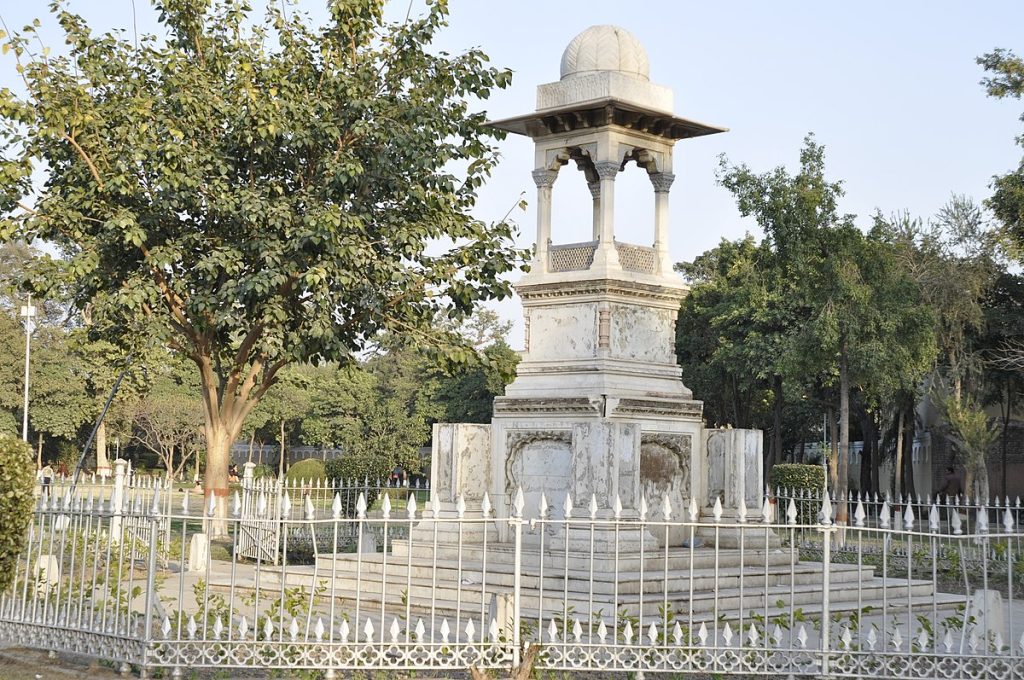
The tomb of Sir James Lyall, can still be found in Faisalabad (formerly Lyallpur) today.
The city itself bore the colonial name of Lyallpur, after Sir James Lyall, who helped spearhead canal colonization in the region. However, in 1979, as part of a broader movement to shed colonial-era identities and embrace Islamic unity, the city was officially renamed Faisalabad in honor of King Faisal of Saudi Arabia. The change was emblematic of Pakistan’s shifting post-colonial identity and its deepening ties with the Muslim world, especially during an era of heightened religio-political realignment under General Zia-ul-Haq.
The City as a Clock Face
But Ghanta Ghar is more than a static monument. Its placement was strategic, surrounded by eight bazaars radiating out in a pattern mirroring the Union Jack, a visible stamp of British colonialism impressed upon the subcontinent’s urban development. Designed by Sir Ganga Ram, a visionary engineer and philanthropist, this layout allowed trade and transit to converge at a single focal point, making Ghanta Ghar both a literal and metaphorical center of civic life.

An aerial view of Faisalabad today, showing Ghanta Ghar as the literal nucleus of the city.
The Man Behind the Layout: Sir Ganga Ram
Sir Ganga Ram (1851–1927) was a civil engineer, architect, and philanthropist whose influence shaped much of colonial Punjab’s urban development. Born in Mangtanwala (now in Pakistan), he studied engineering at Thomason College, now IIT Roorkee. Renowned for his contributions to both Lahore and Lyallpur (now Faisalabad), Ganga Ram combined British engineering principles with native sensibilities, leaving behind a legacy of civic utility and elegance.

A top-down view of Ghanta Ghar at night reveals the city’s lit avenues streaming toward it, like veins to a heart, pulsing with life, memory, and motion.
In Lahore, he was responsible for designing landmark institutions such as the General Post Office, Lahore Museum, Aitchison College, and the hospital that still bears his name. In Faisalabad, he applied his urban planning acumen to devise the radial design of the eight bazaars around Ghanta Ghar, making it one of the most distinctive city layouts in South Asia. More than an engineer, he was a benefactor: donating vast tracts of land, investing in irrigation and agriculture, and funding public infrastructure.


Sir Ganga Ram (left) and a street view of Ghanta Ghar (right)
In recognition of his extraordinary service, he was awarded the title of Rai Bahadur—an honorary designation given by the British colonial administration to distinguished Indian citizens for their loyalty and public service. The title combined ‘Rai,’ a traditional North Indian honorific, and ‘Bahadur,’ a Persian term meaning brave or honorable. It was one of the highest titles a native could receive under British colonial rule and often served as a precursor to further imperial recognition.
Later, in 1922, he was knighted by King George V, officially becoming Sir Ganga Ram. These honors reflected not only his engineering brilliance but also his unwavering dedication to public welfare. While he worked within the machinery of British colonial administration, his works are remembered for serving the people of Punjab—a bridge between colonial modernity and indigenous need.
A Hospital Built to Heal a City
Among Sir Ganga Ram’s most enduring legacies is the Sir Ganga Ram Hospital, founded in 1921 in Lahore as a gift to the people of Punjab. Financed from his personal wealth and designed with the same civic foresight that shaped Ghanta Ghar, the hospital was built to deliver modern medical care in a setting that prioritized hygiene, accessibility, and dignity. It quickly became one of the most advanced healthcare institutions in the region, offering services to all regardless of background—an extension of Ganga Ram’s belief in public service over prestige.


Sir Ganga Ram Hospital Lahore (left) and Sir Ganga Ram Hospital New Delhi (right)
Though Partition reshaped the region, the spirit of his philanthropy carried on. In 1954, a second Sir Ganga Ram Hospital was established in New Delhi by his family, continuing his legacy of healthcare excellence on both sides of the border. Today, both institutions stand not only as hospitals, but as monuments to a man who engineered not just buildings, but better lives.
Marketplaces in Motion
The eight bazaars each hold their own character. Katchery Bazaar is known for electronics, mobile accessories, and government-related offices, making it one of the busiest due to its administrative proximity. Chiniot Bazaar is a favorite for homeware shoppers, offering high-quality curtains, bedding, and fabrics that blend practicality with traditional design aesthetics. Aminpur Bazaar serves as a hub for books, stationery, and printing services, making it a go-to place for students and professionals alike. Bhowana Bazaar is famous for its aromatic offerings of dry fruits, spices, and herbs—arguably the most sensory-rich of the bazaars and a haven for culinary enthusiasts.

Fruit Vendors gathering near Faisalabad’s Jhang Bazaar
Jhang Bazaar is synonymous with the city’s vibrant textile trade, featuring lawn, cotton, and silk fabrics, and is central to Faisalabad’s identity as a textile capital. Montgomery Bazaar, also called Sutar Mandi, is a hardware haven filled with electrical appliances, hand tools, sewing machines, and repair shops. Karkhana Bazaar is the industrial corridor of the city, dealing in machinery parts, raw materials, and wholesale goods that support the manufacturing sector. Lastly, Rail Bazaar is renowned for leather goods, shoes, bags, and accessories. It has historically catered to rail workers and travelers, giving it a practical and durable focus.
These are all tied together by Gole Bazaar, a circular market around the tower that pulses with commercial energy.
The Clock That Heard Everything
Throughout the decades, Ghanta Ghar has served as more than a timekeeper. It has witnessed British colonization and rule, Partition, the birth of Pakistan, and generations of civic change. From Independence Day parades to Eid processions and political rallies, the tower has been a backdrop to the city’s most pivotal and passionate moments. Many locals still recall the echoing sound of the hourly chimes, though today the clock’s mechanisms struggle with maintenance in the face of urban pollution and neglect.
The mechanical clock system at the heart of Ghanta Ghar was imported from Bombay (now Mumbai) during its construction and was a sophisticated piece of engineering for its time. The mechanism was originally designed with a manual winding system and a set of calibrated gears and escapements that regulated four individual clock faces, each facing one of the eight surrounding bazaars. This strategic placement ensured that the time could be read from every direction in the city’s commercial core.


A closer look at one of Ghanta Ghar’s four identical clock faces.
The tower originally included an audible chime system, which struck the hour to signal the passage of time to both traders and residents. This acoustic feature was not merely ornamental, it played a civic function in an era when personal timekeeping devices were rare. The chime bell was connected to the clock mechanism via a hammer system that engaged automatically with each hour.
The clock faces themselves were crafted from durable metal frames with glass inlays, and illuminated during the night by gaslight in the early years, later replaced by electric bulbs. Despite age and wear, some of the original framework remains intact. However, decades of minimal upkeep, shifting environmental conditions, and increasing urban air pollution have led to gradual mechanical deterioration. Today, the clock occasionally stops or shows inconsistent times, and the chimes are often silent.
Efforts have been made periodically to restore the clock mechanism, often initiated by local municipal bodies or historical preservationists. However, these efforts have typically been short-lived or under-resourced. There is a growing recognition that preserving the functionality of the clock is not just a matter of nostalgia, it’s a matter of safeguarding Faisalabad’s living history.
Stories in the Stones
Ask a shopkeeper nearby or a grandparent raised in Faisalabad, and you’ll likely hear stories of how people used the tower to tell time before watches were common. Children gathered around it after school, paramours met beneath it during less conservative times, and generations have referred to directions not by GPS coordinates, but in relation to their position from Ghanta Ghar. “Two streets past Ghanta Ghar and turn left” is still a phrase that lives on in everyday conversation.


Two beautiful paintings featuring Ghanta Ghar by Pakistani artist Maryam Mughal
For many, the tower is tied to family memory. Elders recount how their fathers set their daily routines to the clock’s chimes—opening shops, beginning prayers, or ending work. Street vendors recall watching shadows fall a certain way on the tower before packing up for the day. During times of curfew or political unrest, the Clock Tower became both a marker and a meeting point, a quiet constant amid uncertainty.
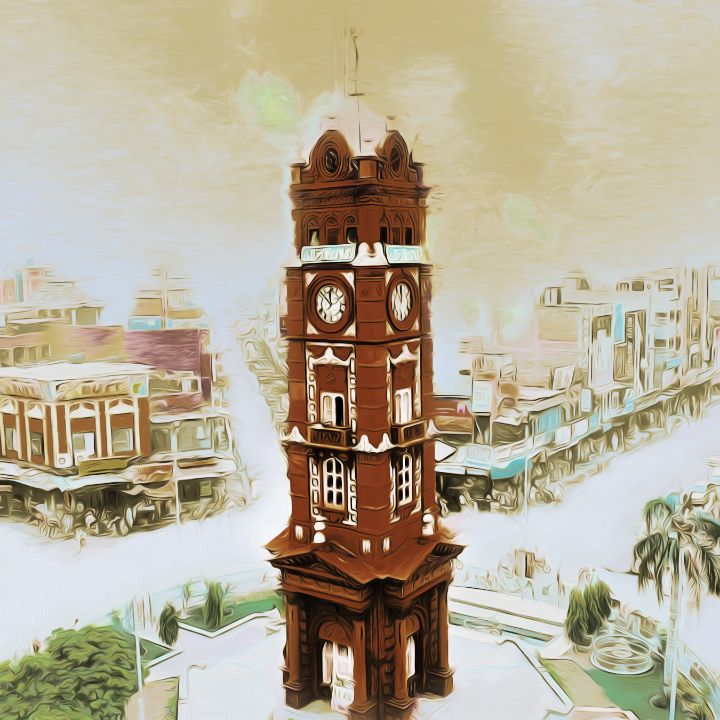

Two more amazing depictions of Ghanta Ghar by artist GullG (left) and an unknown artist (right)
The tower is also an anchor in local identity. Artists paint it in vibrant watercolors, students sketch it in school art classes, and poets reference it as a metaphor for endurance and nostalgia. Local businesses and institutions adopt its silhouette as part of their logos, using it to signal both credibility and hometown pride. Ghanta Ghar has entered not just the city’s skyline, but its psyche—standing as a silent witness to lives lived, markets traded, stories exchanged, and generations grown under its watchful face.
Worn, Not Weakened: Time’s Patina on the Stone
Time has not been uniformly kind. Urban sprawl, traffic congestion, and increasing air pollution have weathered the red sandstone. Conservation efforts exist, but are often underfunded or inconsistent. Studies now explore how to protect this landmark from further deterioration, recognizing that saving Ghanta Ghar is not just about heritage, but about civic soul.
Among Giants, The Heart Still Ticks


Another couple of shots depicting Ghanta Ghar and its symbolic placement as the heart of Faisalabad’s infrastructure.
Compare it to Big Ben in London, Rajabai Tower in Mumbai, or the İzmir Clock Tower in Turkey—Ghanta Ghar holds its own among global civic timepieces. But while many such towers were built to impress, Faisalabad’s tower has endured to serve. It isn’t just photographed; it’s lived with.
To walk the bazaars that circle Ghanta Ghar is to step through a living history of Faisalabad—a place where colonial remnants, local craftsmanship, commercial lifeblood, and communal memory meet at the ticking intersection of past and present. As the city continues to evolve, the tower remains, quietly marking time, waiting for the next generation to look up and listen.
If memory had a landmark, in Faisalabad, it would be Ghanta Ghar.
Want more stories where time meets place? Explore the world one watch (and one city) at a time at bowearswatches.com—where every tick has a tale.