

A Playground Game of Memory, Ritual, and Tradition
It began, as many things do in this age, with a photograph. Scrolling through Instagram one evening, I came across a post from OWL — Old Watch Lady — who had shared a striking image of a couple of glossy brown chestnuts. When you have a moment, you should definitely check out her Instagram page, @oldwatchlady, if you want to see one of the coolest and most robust watch collections I’ve come across. The photograph had a warmth to it, a nostalgic air almost, of something grounded and old. Curious, I sent her a message: “What are those?” I actually thought they were some type of coffee bean at first.
Her reply was a single word: “Conkers.”
That one word carried me unexpectedly backward in time. I heard my father’s voice, from when I was younger, telling me stories of his school days in England. First in Eastbourne, and later in Oxford, he would recount the rituals of autumn, when he and his friends collected horse chestnuts and transformed them into projectiles of playground glory. “We played a game called conkers,” he once told me, and though I only half understood the rules as a child, I remembered the happiness in his eyes as he described it…
…so of course I immediately called him.

The charming country side of Eastbourne, England
The Rules of the Game
The game itself was disarmingly simple. A conker — the seed of the horse chestnut tree — was threaded with string or shoelace, knotted at one end to keep it from slipping free. Two players faced off. One dangled their conker while the other swung theirs from a fixed height, attempting to smash it with a sharp, satisfying crack that echoed across the schoolyard, drawing cheers or groans from the watching crowd.


The match went on, alternating blows, until one conker split or shattered. Victory went to the survivor, which was elevated in status by the number of matches it had endured. A conker that won its first game was called a one-er, a second victory made it a two-er, and so on. Among children, a high-ranking conker was an object of awe — proof of both luck and skill, whispered about in the corridors of boarding schools and on the edges of playgrounds.
Whats in a Name?
Even the word conker carries a touch of mystery. While it feels naturally linked to the idea of conquering an opponent, the name doesn’t come directly from conqueror. Instead, it seems to be the result of several threads of language and tradition weaving together over time.
Some believe the game was first called “conquerors,” and since the goal was always to triumph over your opponent’s chestnut, the shift into conker happened almost effortlessly in the playground. Others point to an older dialect word for snail shells. Before horse chestnuts became the weapon of choice, children played the same game with snail shells or hazelnuts, and when chestnuts took their place, the name came with it. That explanation also hints at French connections: the word conque means “conch” or “shell,” and another French verb, cogner, means “to hit.” Both fit the game perfectly. And then there is the simplest explanation of all—that conker might just be onomatopoeia, echoing the crisp conk of two chestnuts colliding.
The first written uses of the word appear in the mid-1800s, right when horse chestnuts were becoming standard. Like the game itself, the name resists a single origin. It is a small reminder that some of the most enduring traditions are not born from certainty, but from the playful overlaps of sound, memory, and imagination.
Folklore, Tricks and Superstitions
As with most playground traditions, the official rules only tell part of the story. The real magic of conkers lived in the folklore: the whispered tricks, the secret rituals, the unshakable beliefs about how to create an unbeatable champion.

Some children swore by soaking theirs in vinegar, convinced the acidic bath would transform a soft, glossy seed into something like stone. Others insisted on baking them gently in the oven, or rubbing them with oil to give them a deceptive sheen of toughness. A favorite trick was to leave a conker drying on a windowsill for weeks, letting the sun harden its shell until it felt almost metallic to the touch.
One of the most enduring beliefs was that older conkers were tougher than new ones. To find a year-old conker—deep brown, shrunken slightly, with the patina of age—was to stumble on buried treasure. These “veterans” were whispered about like returning champions, said to carry the scars and seasoning of survival. Children would stash them carefully in drawers or jars, bringing them out with a mix of pride and secrecy when conker season arrived again. A fresh seed might be bright and handsome, but an aged one had a reputation: hard as iron, stubborn, nearly indestructible.
Debates were endless and passionate. Some claimed bigger conkers had more striking power; others argued that smaller, denser ones resisted shattering. Even the way you threaded the string could spark long arguments—through the eye, across the flat, or knotted twice for luck. A child who tapped their conker against the ground three times before playing might swear that it gave them a winning edge, while another would insist on never letting anyone else touch theirs before a match.
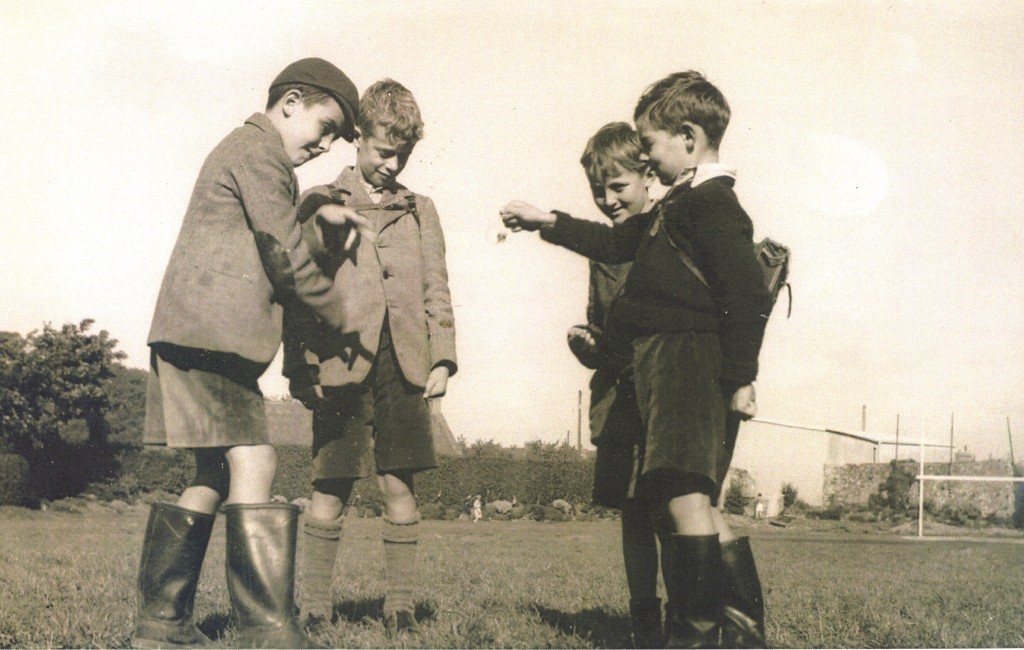
School kids playing Conkers on the playground.
Of course, none of these tricks were officially sanctioned. In formal competitions they were considered cheating, and in truth, much of their power lay in belief rather than fact. But that was precisely the point. Conkers was as much about ritual and imagination as it was about splintering shells. Every playground held its own whispered lore, and every child carried the conviction that their secret method would tilt the odds in their favor.
A Seasonal Rite of Passage
In Britain, conkers became an almost seasonal rite of passage. Each autumn, when the trees dropped their horse chestnuts, children rushed to collect them, filling pockets and satchels with the smooth brown seeds. Cold fingers dug through fallen leaves, pockets bulging with treasure, each polished seed carried home like a trophy. There was a seasonal rhythm to it, almost like the cycle of swapping straps with the change of weather — a tactile way of marking time as the year turned. Games would erupt in playgrounds, alleys, and back gardens. Schoolyards rang with the sound of cracking shells, cheers of triumph, and groans of defeat.

For many, the game embodied the rhythm of the seasons: the arrival of autumn signaled not just colder weather and shorter days but also the chance to compete, to create stories and legends around objects plucked from the ground. It was a way of making something magical out of the ordinary, of transforming a chestnut into a champion.
From Playground to Championship
Though conkers began as a simple children’s pastime, it grew into something larger. In 1965, the village of Ashton in Northamptonshire began hosting the World Conker Championships, a quirky tradition that draws players from around the world (moved to a larger venue in Southwick in 2009). Contestants use official, untreated conkers and follow codified rules, battling through rounds until a champion is crowned. The event has become part carnival, part nostalgia trip, ensuring that the game continues even as it fades from daily playground life.
Conkers, of course, comes with its own drama. In 2024, 82-year-old David Jakins was crowned “King Conker” after outlasting the field—only for accusations to fly that he had smuggled in a steel chestnut painted to look real. For a moment, it looked like conkers had stumbled into its very own doping scandal. After much reviewing of footage and judge testimony, however, officials cleared him of wrongdoing, and his title stood. Even in a game of horse chestnuts on strings, it seems, there’s room for controversy, intrigue, and the occasional courtroom-style flair.

An image from this BBC article about David Jenkins and his saga.
This sense of formality underscores just how deeply conkers is woven into British cultural memory. It is not merely a game but a shared story, one that links generations together through the collective memory of autumn afternoons and shattered shells.
Yet as conkers took on this air of formality, their future in everyday childhood was less certain.
Safety, Myth, and Decline
No discussion of conkers would be complete without addressing the myths that swirl around it. In recent decades, stories have circulated of schools banning the game due to health and safety concerns. Children, it was said, were at risk from flying shards or bruised knuckles. In some cases, protective goggles were reportedly introduced — a detail that newspapers seized upon with glee.
The reality is more nuanced. While a few schools discouraged the game or added safety measures, outright bans were rare. In some cases, the debate around conkers became wrapped up with broader health concerns, including the emerging awareness of nut allergies in school settings. Though horse chestnuts themselves are not the same as edible nuts, the association was enough to make some administrators uneasy. Over time, these stories grew larger in the public imagination than the truth itself. The idea of conkers as a “banned game” became part of the cultural lore, reinforcing its status as a symbol of a freer, rougher childhood compared to the perceived overprotectiveness of modern times.
At the same time, broader social shifts played a role in its decline. The rise of digital entertainment drew children away from playgrounds, and conkers, once a common ritual, became a curiosity. Today, the sight of children battling with chestnuts on strings is increasingly rare. And yet, for all the myths and shifting attitudes, the heart of conkers lives on in memory.

A screen grab from the BBC show Top Gear where the hosts decide to play Conkers with a pair of caravan trailers.
Memory and Tradition
For me, the word conkers now carries two layers of memory. There is the cultural one — the heritage of a game that defined generations of childhoods in Britain. And there is the personal one — my father’s voice, his stories of Eastbourne and Oxford, the way his eyes still light up when he describes the thwack of one chestnut colliding with another and the competitive spirit it induced.

Eastbourne, England’s beautiful coast.
It is remarkable how something so small, so ordinary, can be so deeply tied to identity and memory. A chestnut becomes a conker, a conker becomes a champion, and a champion becomes a story told decades later.
In the end, conkers is more than just a playground game. It is a reminder of how tradition is made: not through grand rituals but through small, repeated acts that embed themselves into our sense of self. Children threading chestnuts onto string each autumn were not just playing — they were participating in a cycle of memory, one that tied them to the season, to each other, and to those who came before.
And sometimes, all it takes is a photograph on Instagram and a single word to unlock that entire chain of memory — not unlike the way a glance at a watch can return you to a moment, a place, a story you thought you’d forgotten.
Time lives in the small rituals we carry — a chestnut on a string, a watch on a wrist. If you’d like to keep exploring where memory and horology meet, check out www.bowearswatches.com and follow me on Instagram @bowearswatches and join our journey.


