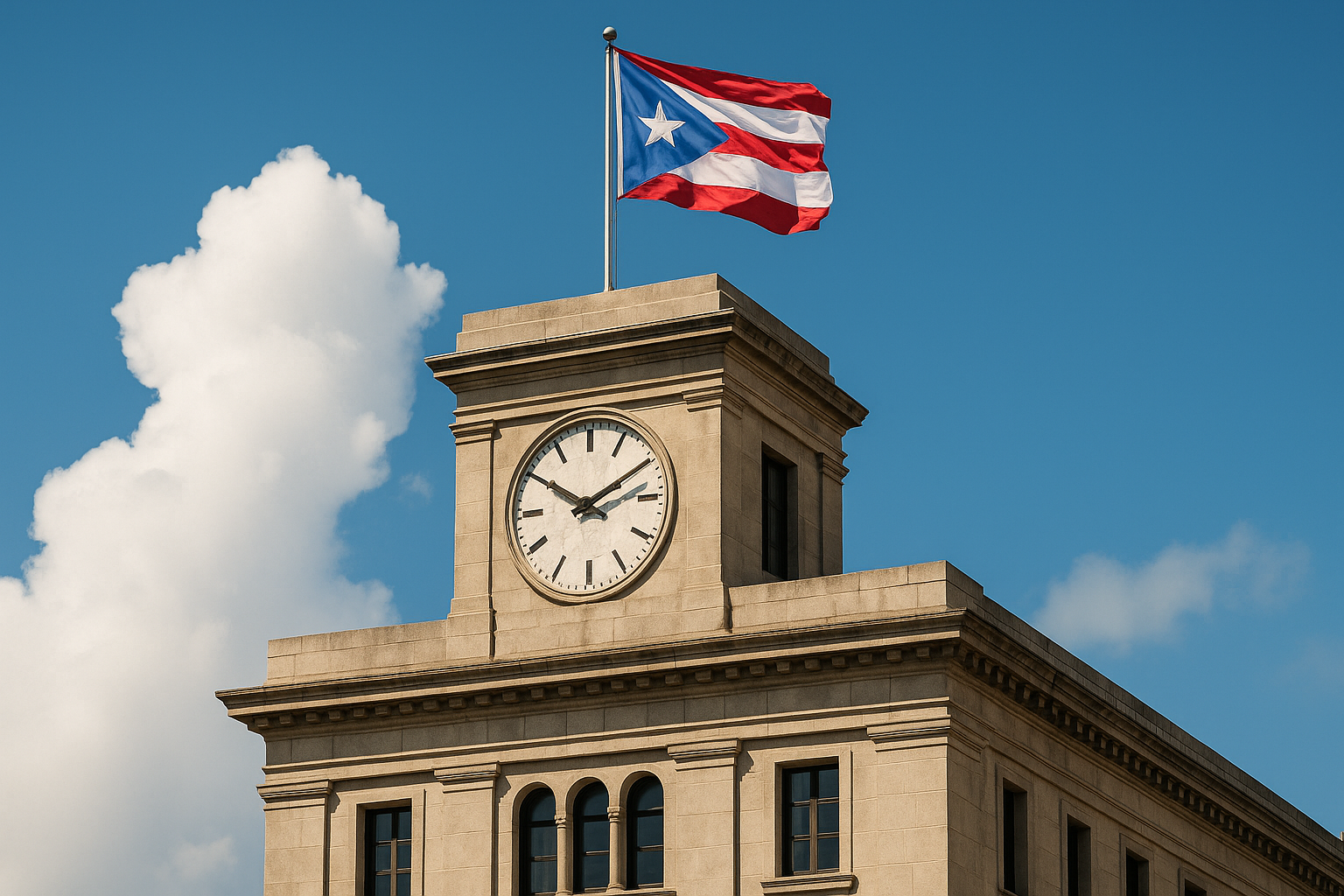
From La Fortaleza’s fractured timepiece to Banco Popular’s modern glow, Puerto Rico’s clocks have marked not just the hours, but the evolving story of the island itself.
After publishing my first article about Puerto Rico’s iconic university clock tower—A Clocktower in the Caribbean: The Watcher of San Juan—I was met with a few thoughtful responses. One message stood out in particular and offered a perspective I hadn’t yet explored. It came from a friend, a fellow watch enthusiast and horologist who also happens to be a native of Puerto Rico. He had enjoyed reading the piece about La Torre, a beacon of academia and cultural pride, but gently reminded me that it isn’t the only timekeeper to have left its mark on the island’s collective memory.


La Torre (left), Banco Popular’s San Juan Building (middle) and La Fortaleza as seen from the street in Old San Juan (right).
There are other clocks across Puerto Rico that, while perhaps less ornate or historic than La Torre, hold a deep and familiar place in the daily lives of its people. These were clocks marked by history, perched on bank towers, glimpsed from car windows, or even heard over the phone when calling for the exact time. Chief among them were La Fortaleza’s grand clock and the timepieces of Banco Popular. These weren’t merely devices for keeping time; they stood as symbols of order, reliability, and civic rhythm. Whether glowing in red digits or ticking behind stately analog faces, these clocks shaped not only schedules, but a shared sense of structure and trust.
That conversation got me thinking: if La Torre is the academic heartbeat of timekeeping in Puerto Rico, what role did the clocks of commerce play? How did banks—those keepers of capital—also become keepers of time?
This article is the result of that question: a journey through the public clocks of Banco Popular, the cultural and commercial weight they carried, and the broader story of how time itself became a symbol of trust, identity, and aspiration in Puerto Rico.
A Sword Through the Face of Time
In the summer of 1898, the Spanish Empire, historically once vast and global, was nearing the end of its centuries-long reign in the Americas. After the brief but decisive Spanish-American War, the Treaty of Paris was set to transfer sovereignty of Puerto Rico from Spain to the United States. And as with many endings, there came a gesture that has since lived on more in legend than in the written record, but a powerful one nonetheless.
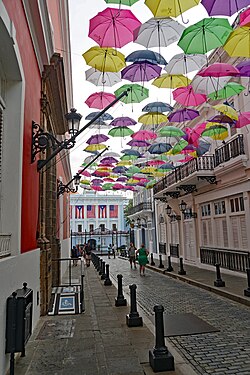

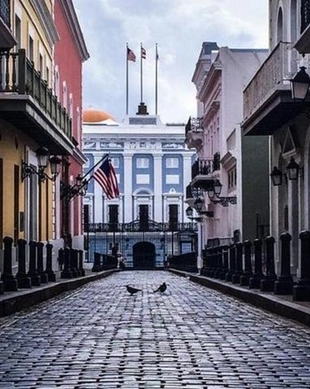
Umbrella street decoration Calle de la Fortaleza, Old San Juan (left) and the gardens inside Calle de la Fortaleza (right)
According to local lore, just before the U.S. formally took possession of the island, General Ricardo de Ortega y Diez, the final Spanish military governor of Puerto Rico, made a final, symbolic act. Standing inside La Fortaleza, the governor’s executive residence in Old San Juan, Ortega is said to have drawn his ceremonial sword and struck the face of the mansion’s grand clock. The strike cracked the glass—perhaps even bent the hands. In doing so, he marked not just the literal moment of Spain’s departure, but the figurative end of an empire’s time on Puerto Rican soil. While no official record confirms the act, the story endures because it speaks to a deeper truth—that an empire’s clock had struck its final hour.
This moment, whether apocryphal or precisely factual, has been preserved in cultural memory as a powerful metaphor: Spain’s time had run out. The broken clock, still visible today within La Fortaleza, became more than a damaged mechanism. It became a relic of transition, a silent witness to the island’s shift from one colonial power to another. In a place where symbolism matters deeply, it remains one of Puerto Rico’s most evocative timepieces.
Ricardo de Ortega y Diez: The Last Governor


A lithographic image of General Ortega from Puerto-Rico, 1897 (left), A beautiful hallway inside La Fortaleza (right)
A seasoned Spanish general, Ricardo de Ortega had served in various military posts throughout Spain’s territories, including Cuba and the Philippines, before arriving in Puerto Rico. His time as governor was brief, less than a year, but still historically significant. When U.S. troops landed in Guánica in July 1898 and marched toward San Juan, Ortega led the island’s defense until the armistice was signed. Though the Treaty of Paris would not be officially ratified until December, Spain’s effective rule ended with that summer’s surrender. Ortega’s clock strike, if it happened as local legend suggests, was his final gesture, one not of resistance, but of resignation.
La Fortaleza: A Mansion Through the Ages
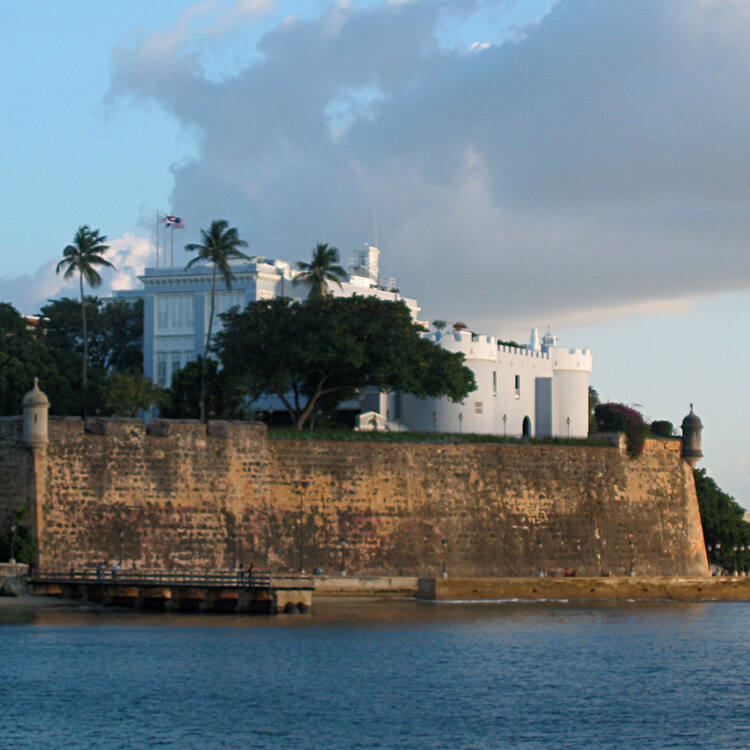
A view of La Fortaleza from the water
Built between 1533 and 1540 to defend San Juan’s harbor, La Fortaleza was originally a military outpost, its name appropriately meaning The Fortress. Over time, it evolved from a protective bastion into a more domestic and ceremonial space. By the mid-19th century, it had become the official residence of the Spanish governors of Puerto Rico. With the change of sovereignty in 1898, it continued in that role, making it today the oldest executive mansion still in continuous use in the Western Hemisphere.

Another couple of glimpses into La Fortaleza’s beautiful interior.
Architecturally, La Fortaleza blends elements of military, Spanish colonial, and neoclassical design. Its thick stone walls, turreted lookout towers, and arched walkways give it the feel of a fortress and a home in equal measure. Over the centuries, it has hosted kings, presidents, dignitaries, and dissidents. It has seen uprisings, hurricanes, protests, and pageantry. But perhaps no moment captures its historical weight more poignantly than that supposed clock strike—a single blow that signified the end of one era and the uncertain beginning of another.
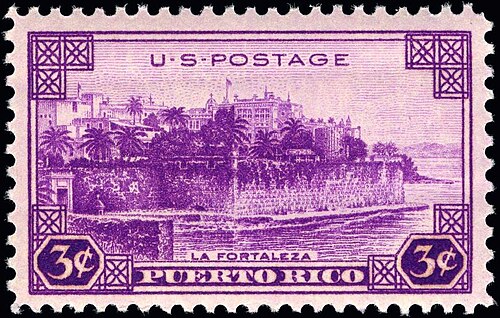
La Fortaleza as displayed on a postage stamp from 1937.
Today, the damaged clock remains, a quiet fixture on a building filled with ceremonial splendor and administrative purpose. It does not toll like the bells of a campus tower or glow like the digits on a banking high-rise. But it tells a story, nonetheless. A fractured one. A timeless one.
Unfortunately, finding a publicly accessible image of the specific clock inside La Fortaleza, which General Ricardo de Ortega y Diez is said to have struck in 1898, proves challenging. As the official residence of the Governor of Puerto Rico, La Fortaleza maintains limited public access, and detailed images of its interior, particularly of historical artifacts like the clock, are scarce. Archival materials and firsthand accounts remain the primary sources of information about this symbolic moment in the island’s history.
Clocks as Symbols of Power
In cities around the world, public clocks have long served dual purposes. On one hand, they are practical and offer time to the masses and on the other, they are declarative. A prominent public clock doesn’t just tell time; it insinuates that someone or some institution, owns or controls time. From medieval clock towers in Europe to railway stations in the Industrial Age, clocks have communicated trust, stability, and control. In Puerto Rico, that role was taken up not just by churches or government buildings—but by a bank.
Banco Popular: The Banker That Told Time
For most of the 20th century, Banco Popular didn’t just shape Puerto Rico’s financial landscape, it also shaped how the island perceived time. In a tropical, sun-steeped land where the rhythms of daily life have always danced between the formal and the fluid, Banco Popular introduced something fixed and ever-visible: public clocks.


Banco Popular’s Hato Rey Headquarters, with its large digital display
One of the earliest of these timekeepers was installed in 1939, atop Banco Popular’s art deco tower in Old San Juan. At the time, it was the tallest building on the island and it boasted an analog clock that quickly became a trusted visual anchor for locals navigating the historic district.
Two decades later, Banco Popular did it again, this time with modern flair. In 1965, the bank unveiled its new headquarters in the Hato Rey district of San Juan. Hato Rey, once a barrio within the former municipality of Río Piedras (which merged with San Juan in 1951), had by the mid-20th century become the island’s financial district, a fitting home for Banco Popular’s modernist aspirations. The tower was sleek, tall, and unmistakably modern. And crowning it all was a massive digital clock. It was visible from the highway, from the train lines and from nearly any angle in the financial district. It glowed red in the dark and pulsed with quiet authority.


Banco Popular’s Hato Rey Headquarters, with its large digital clock (left), a 1947 image of Banco Poplar’s original San Juan Art Dec inspired tower with the clock on its side (right).
For generations of Puerto Ricans, that clock became the time. People would glance at it from cars and buses, set their wristwatches by it, and even call a special Banco Popular phone line just to hear a recording of the exact time. “I remember calling that number as a kid,” my friend told me. “It was how we synchronized everything.”
In a world before smartphones and atomic sync, this mattered. Deeply. The clock atop the tower wasn’t just a digital display, it was an unspoken promise: Trust us with your money and your time. We keep accurate time, and we’ll keep your balance accurate too.
Banco Popular: A Brief History of Puerto Rico’s Most Enduring Bank
To understand why a clock on a building could carry so much symbolic weight, you have to understand the institution beneath it.


The Banco Popular Building in Río Piedras, whose original charm has been impacted by the change of its neighborhood (right)
Banco Popular de Puerto Rico was founded in 1893, five years before Puerto Rico shifted from Spanish to American control. It began as a modest savings bank in San Juan, founded by a group of civic-minded Puerto Rican professionals who believed that access to capital should be more equitable. At the time, banking services were mostly reserved for the elite, and the island’s economic infrastructure was underdeveloped. Banco Popular’s mission was simple but revolutionary: to make banking accessible to all Puerto Ricans.


Banco Popular’s brand and log evolution over the years (left), The original art deco inspired Banco Popular tower in San Juan.
In the years that followed, the bank quickly became an anchor of financial life on the island. After the U.S. invasion and subsequent economic restructuring, Banco Popular not only survived the transition, it adapted. It grew steadily through the 20th century, opening branches across towns and cities, and earning a reputation as a trustworthy, community-rooted institution. By the mid-century mark, it was already the largest bank on the island and still holds that position to this day.

Students from the musical programs of the Banco Popular Foundation and the Arturo Somohano Philharmonic Orchestra
But Banco Popular didn’t just grow financially. It evolved into a cultural icon. Its advertising campaigns became household jingles. Its annual televised Christmas specials brought together beloved Puerto Rican artists, musicians, and celebrities. These holiday programs weren’t just branding, they were community events that fused commerce with culture.

Custom-composed audio branding performed by Puerto Rican singer-songwriter Tommy Torres helps audiences connect with Popular through sound.
This is what made Banco Popular’s clocks so impactful. They didn’t just represent a corporate entity. They represented stability, modernity, and identity. At a time when many Puerto Ricans were navigating complex economic, political, and cultural transitions, the bank’s clocks offered something constant: a rhythm they could trust.
More Than Banking: The Christmas Specials That Became Tradition
Banco Popular’s influence in Puerto Rico extended well beyond finance. Beginning in the early 1990s, the bank began producing annual televised Christmas specials—lavish musical programs that quickly became a beloved part of the island’s holiday season. These specials, known as “Especiales de Navidad de Banco Popular,” featured some of Puerto Rico’s most celebrated artists and musicians, blending traditional Christmas songs with Afro-Caribbean rhythms, contemporary arrangements, and deep cultural storytelling.
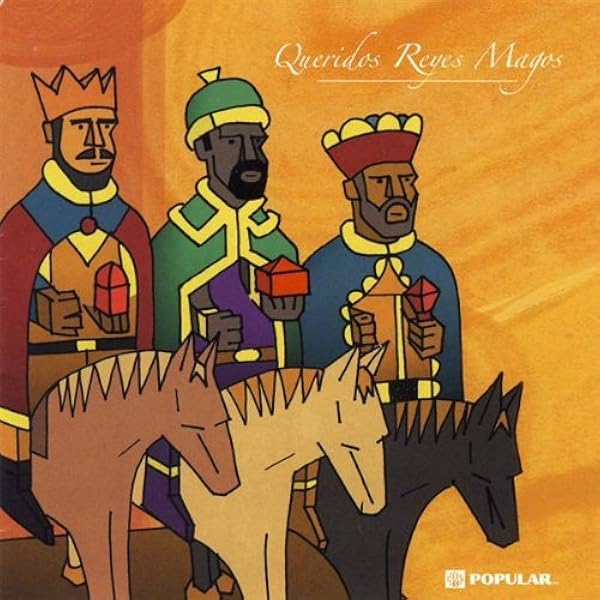
Cover art from the “Viva Navidad; Banco Popular Special” from 2006
More than corporate marketing, these productions became cultural events—watched by families across generations, aired on national television, and distributed on CD and DVD throughout the diaspora. Each year’s special centered on a theme: honoring Puerto Rican heritage, revisiting musical legends, or celebrating resilience in the face of hardship. In doing so, Banco Popular positioned itself not just as a steward of the economy, but as a curator of national identity—using music, memory, and celebration to reinforce its place in the cultural fabric of the island.

A show presenting “The Christmas Story” put on by Banco Popular in 2023
In a world where few banks are remembered for their artistic output, Banco Popular became the rare exception: a financial institution that helped soundtrack Puerto Rico’s holidays and strengthened its emotional ties to home.
Taller Than Time
For nearly seventy years, from 1939 to 2009, Banco Popular held the title of Puerto Rico’s tallest building. From its original Old San Juan headquarters to the Hato Rey skyscraper that replaced it, the bank’s physical prominence echoed its institutional dominance. Its clocks, therefore, weren’t accessories, they were declarations.
Before Hato Rey’s digital display, the clock tower at the University of Puerto Rico (UPR) had briefly held the title of tallest building (from 1937 to 1939). But even as La Torre continued to ring out chimes of enlightenment, Banco Popular’s buildings grew taller, more modern, more central to daily life. In time, they took over the skyline, and with them, the symbolic authority that once belonged to churches or universities.
Timekeeping as Corporate Branding
When a clock is placed on a tower, it’s not simply to serve the public. It’s to align an institution with something deeper: the idea of order, of reliability, of permanence. “If you’re the tallest, plus you have an imposing (and presumably accurate) clock,” my friend wrote, “you communicate status, knowledge, and power. You imply that you control time, that you have existed since time immemorial, and that you will exist for all time.”
This strategy wasn’t unique to Puerto Rico. Globally, banks and railway stations—two engines of modern life—have long used clocks to build trust. But in the case of Banco Popular, the clock became not just a utility, but a brand asset. Its presence on the tallest towers turned the bank into something almost mythic: a keeper of time, and thus, a keeper of stability.
Time, Money, and the National Psyche
There’s a deeper metaphor ticking beneath every public clock, one that reaches far beyond schedule-keeping. American Founding Father Benjamin Franklin famously declared, “Time is money.” In many ways, that idea became a cornerstone of capitalist thinking, and banks around the world have embraced it not only in their operations but in their architecture. A prominent clock on a bank’s façade isn’t just ornamental, it’s a declaration. It says: We understand value—in every minute, in every cent. Trust us not just with your finances, but with your future.
But in Puerto Rico, that symbolism runs deeper—because time on this island has always been more than a resource. It’s been a witness, a battleground, and a poetic undercurrent to the lives of people whose resilience runs deeper than any fiscal ledger.
Here, where colonial legacies, political ambiguity, and economic struggle often intersect, public clocks like those of Banco Popular have carried emotional weight. They have stood as beacons of aspiration, quietly reinforcing the idea that progress is not only possible, it is measurable, visible, and shared. In times of uncertainty, when headlines rattled and circumstances shifted, these clocks continued to mark the hours, reminding Puerto Ricans that they too were part of the rhythm of global modernity.

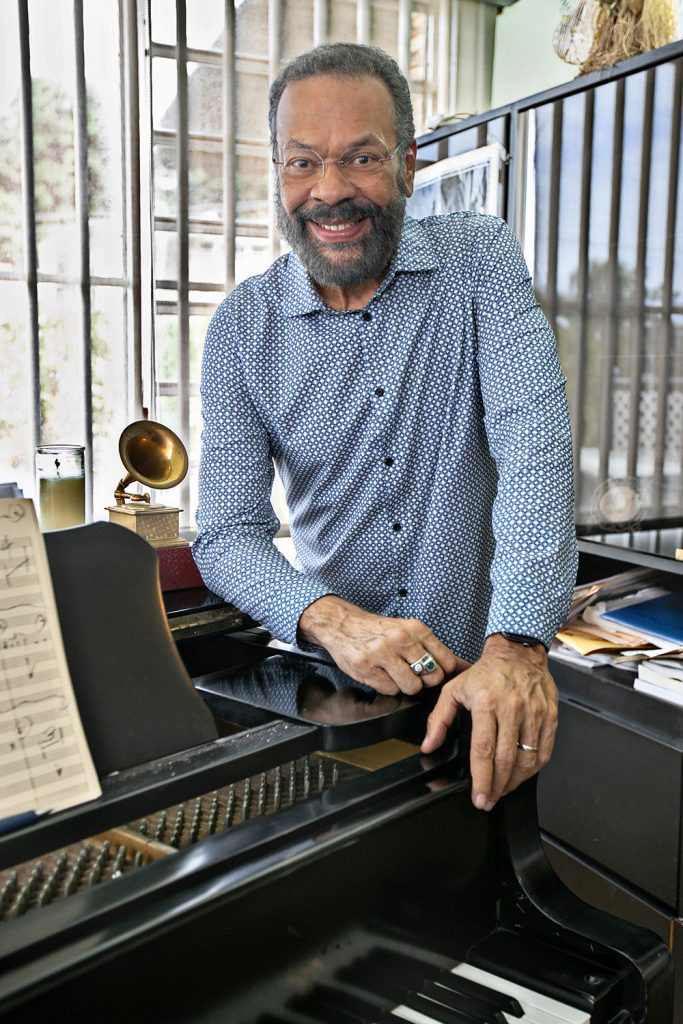
The vibrance of Puerto Rican culture (left), Maestro Ángel “Cucco” Peña, who is part of the campaign developed in collaboration with RosadoToledo& and recorded by the Metrópolis production house, featuring bank employees and local artists (right).
And yet, Puerto Rican culture has never reduced time to mere dollars and deadlines. On this island, time dances. It stretches, bends, and pulses to the rhythms of music, language, and memory. It finds expression in bomba drums and salsa steps, in the slow-savored cafecito, in long conversations on breezy balconies, in festivals that light up entire towns. Puerto Ricans understand the preciousness of time not just as a commodity—but as communion.
It’s precisely this duality—of being grounded in both precision and poetry—that gives Puerto Rican identity its brilliance. The clocks may have echoed with the discipline of the financial world, but the people beneath them infused every hour with meaning. They kept going, adapting, resisting, rejoicing. They turned hardship into humor, scarcity into creativity, and tradition into transformation. The clocks told the time, but the people made it theirs.
So yes, in Puerto Rico, time is money. But it’s also memory. Movement. Music. And maybe that’s the truest form of wealth.
A Quiet Shift
Today, the digital clock atop Banco Popular’s tower still shines, but it competes with phones, watches, and wrist-bound satellites. Public timekeeping has moved from the skyline to the pocket. The drama of towering digits has given way to silent sync. But for many Puerto Ricans, the memory lingers: the glow in the sky, the call to the time hotline, the feeling that the island’s most trusted institution was marking each minute with care.
And yet, there’s still something poetic about the broken clock in La Fortaleza and the digital one above Hato Rey. One symbolizes the moment time broke open; the other, the promise that it could be mastered. Between the two lies a whole century of Puerto Rican history—told in seconds, symbols, and steel.

If La Torre is the soul of Puerto Rico’s academic timekeeping, then Banco Popular’s clocks have been its heartbeat of commerce. One chimes for enlightenment. The other glows for trust. Both mark more than time—they mark belief.
For more stories where horology meets history, follow along at @bowearswatches and www.bowearswatches.com.