The Timeless Guardian of São Bento Railway Station: A Closer Look at Its Historic Clock
If you’ve ever stepped into São Bento Railway Station in Porto, Portugal, you know it’s more than just a train station—it’s a time capsule wrapped in azulejo tiles, history, and architectural grandeur. Most visitors are captivated by the station’s stunning blue-and-white tile murals, but look up, and you’ll find another silent yet ever-present witness to history: the station clock.
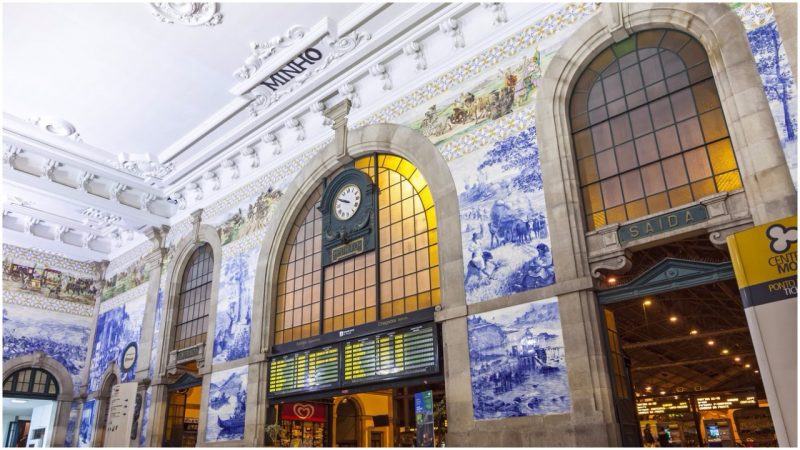
For over a century, this clock has marked arrivals, departures, and life itself in one of the world’s most beautiful train stations. But what do we really know about it? When was it made? Who built it? And why is it just as important as the stunning tile work surrounding it? Let’s dig in.
A Station with a Story: The Birth of São Bento
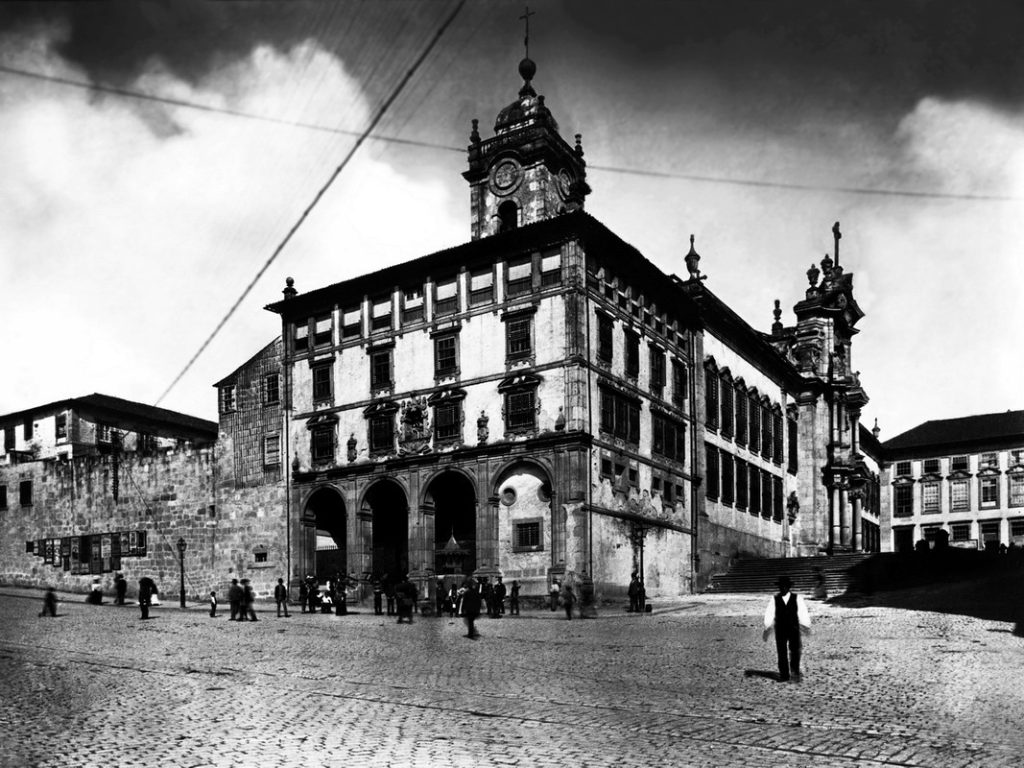

Exterior and interior photos from the monastery before it was demolished.
Before there were trains, there were monks. The site of São Bento Railway Station was originally occupied by the Convent of São Bento de Avé-Maria, a Benedictine monastery founded in the 16th century. By the late 19th century, the monastery was demolished to make way for Porto’s growing railway network, and in 1900, the first stone of the new station was laid.
The man behind its design, José Marques da Silva, blended French Beaux-Arts influences with traditional Portuguese elements, creating a structure that felt as grand as it was functional. While the station officially opened in 1916, it was the stunning azulejo murals, added between 1905 and 1916 by artist Jorge Colaço, that sealed its reputation as one of the most beautiful railway stations in the world.
But among the sprawling artwork, there was another crucial addition—a clock that would keep the city on schedule for the next century.
The Clock: More Than Just a Timepiece
Positioned above the station’s main entrance, the São Bento clock is both a functional necessity and an architectural statement.


From a distance, it seems simple—a classic clock face with Roman numerals, framed within an ornate archway that perfectly complements the surrounding azulejo tiles. But its placement was intentional. Travelers arriving at the station would instinctively look up, not just to admire the architecture, but to check the time. The clock served as the station’s anchor, silently ensuring that passengers, conductors, and station staff all moved in rhythm with the city’s schedule.


A close up of the São Bento clock (left), My wrist with my favorite travel watch, the Seiko SUN065P1 (right)
And while we often think of public clocks as purely practical objects, this one is different. It’s a reminder of the station’s deeper function—not just to move people from point A to point B, but to synchronize life itself.
When Was It Made? And Who Built It?
Here’s where things get tricky. Unlike some of the world’s more famous clocks, São Bento’s timekeeper doesn’t come with a well-documented backstory.


From the era: the St Pancras International station clock in London from 1868 (left) and the Centraal Station clock in Amsterdam from 1889 (right)
We know it was installed sometime between 1900 and 1916, as part of the station’s construction. Given the era, it was likely manufactured by a European clockmaker specializing in public railway clocks, possibly from Portugal, France, or even England—countries known for producing precise, long-lasting timepieces during the early 20th century.
While the artist behind the azulejo murals is widely credited for his work, the station clock lacks the same level of recorded detail. It remains, in some ways, a mystery, quietly ticking away while its story remains partially untold.

These stunning azulejo murals that line the interior walls of São Bento Railway Station are the work of one of Portugal’s most celebrated tile artists, Jorge Colaço (1868–1942). Born in Tangier to a Portuguese diplomat, Colaço studied fine arts in Lisbon, Madrid, and Paris, where he developed a romantic and historical realist style that would later define his work in ceramics.


While azulejo tiles had long been used decoratively in Portuguese architecture, Colaço elevated the medium into a vehicle for storytelling. At São Bento, he created more than 20,000 tiles between 1905 and 1916, covering over 551 square meters. These panels depict pivotal moments in Portuguese history—such as the Battle of Valdevez and the Conquest of Ceuta—alongside vivid scenes of rural life. His murals transform the station into a visual chronicle of Portugal’s cultural and national identity.

Colaço’s work can be seen in palaces, churches, and civic buildings throughout Portugal and even abroad. But it is São Bento that remains his most iconic achievement—a monumental blend of narrative, craftsmanship, and patriotic pride, all rendered in blue and white ceramic.
A Symbol of Porto’s Resilience

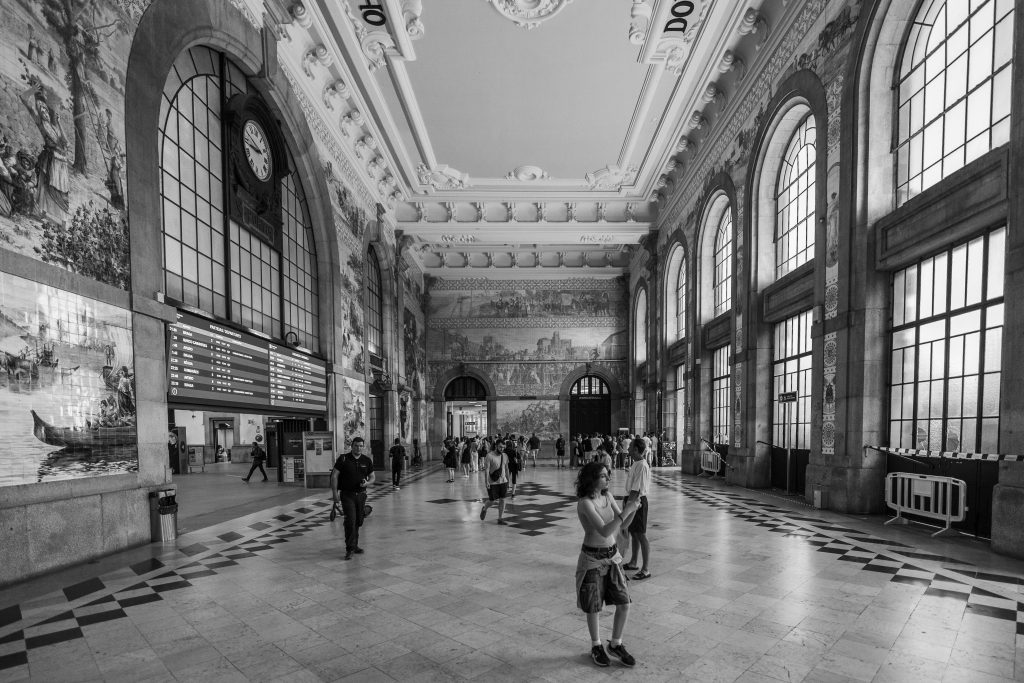
Porto, Portugal (left) São Bento’s main hall (right)
For over a century, the São Bento clock has done more than keep trains running on time. It has stood through wars, revolutions, and the rapid modernization of Portugal. Here are just some of the moments that it has witnessed:
• It was there during both World Wars, keeping its hands moving as Europe fell into chaos.
• It witnessed the Carnation Revolution of 1974, a peaceful military coup that ended Portugal’s dictatorship.
• It ticked through Portugal’s entry into the European Union in 1986, marking the country’s integration into modern Europe.

The magnificent sight that is São Bento Station when it is lit up at night.
Through it all, the clock has remained unchanged, a silent observer as passengers rushed beneath it—some running to catch their train, others pausing to check the time before heading into the city.


It’s easy to take a station clock for granted, but São Bento’s timepiece is different. It represents continuity in a world that’s constantly in motion.
The Role of Time in a Train Station
A train station without a clock is like a watch without hands—pointless.
Historically, railroads were responsible for standardizing time across countries, ensuring that people could depend on set schedules rather than relying on local sunrises and sunsets. The entire concept of “railway time” was built around precision, and stations like São Bento needed a clock that was both highly visible and highly reliable.

Even today, in an era of smartphones and digital displays, there’s something reassuring about seeing a classic analog clock above a station entrance. It grounds you. It connects the past with the present.
And in São Bento, that feeling is amplified by the station’s sheer beauty. The clock isn’t just marking minutes—it’s marking moments.
Preservation and Future
Like the station itself, São Bento’s clock has been carefully preserved. Regular maintenance ensures it continues to function, though it’s unclear whether any significant restorations have been made to its internal mechanisms over the years.
The surrounding azulejo tiles, however, have undergone extensive conservation efforts, ensuring they remain vibrant for future generations. Given the station’s status as a National Monument, any work done on the clock would need to respect its historical integrity, likely handled by specialists in public clock restoration.


Yours truly standing underneath a beautiful tile mural in São Bento’s main hall.
As Porto continues to modernize, São Bento remains one of the few places where time seems to slow down—where people pause to admire the artistry of the past before stepping onto a train that will carry them into the future.
Final Thoughts: Why the Clock Matters
There’s a reason people stop to take photos of São Bento’s clock. It’s not just because it’s old, or because it sits in one of the most beautiful train stations in the world.
It’s because a clock like this feels alive.

In a world of disposable technology and fleeting trends, São Bento’s station clock is a reminder of permanence—of things built to last, of places where time is more than just a number on a screen.
So, the next time you find yourself in Porto, step inside São Bento, take in the murals, and look up. The clock is still there, still keeping time, still watching over the station as it has for more than 100 years.
And in a place like this, that’s exactly how it should be.


Want to see more stories about timepieces in unexpected places? Follow @bowearswatches for a journey through horology—on and off the wrist.